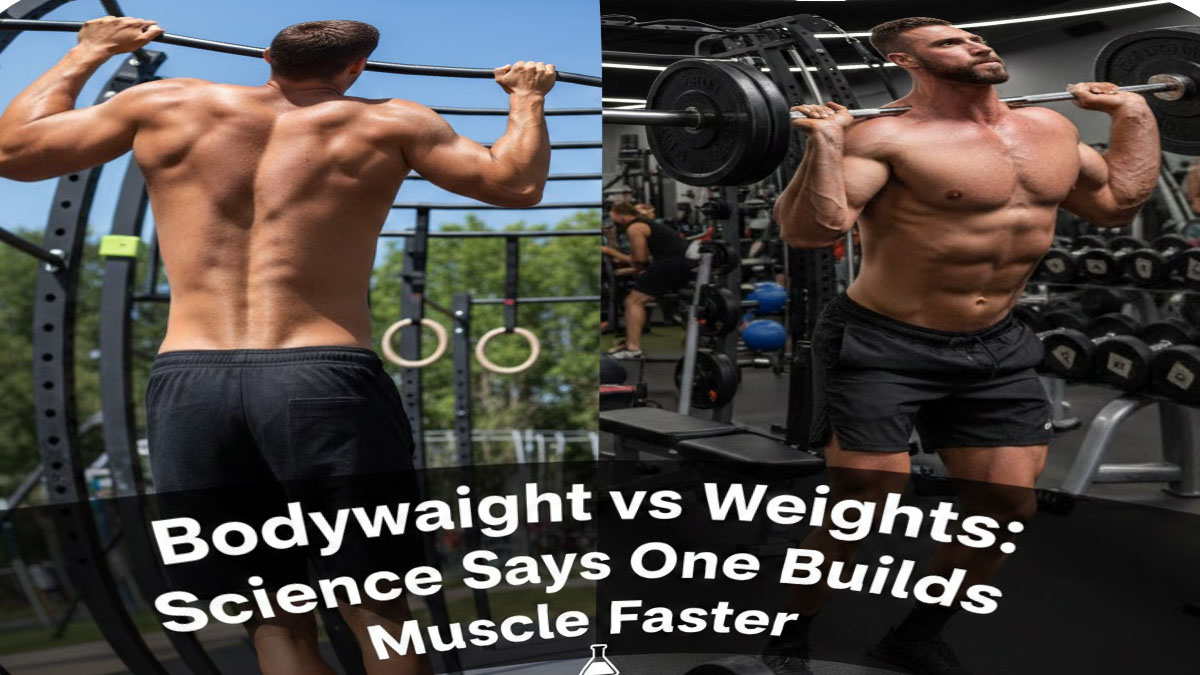
The Ancient Debate, Settled by Science
For decades, fitness enthusiasts have argued: Is bodyweight training enough to build muscle, or do you need weights? The calisthenics purists swear by pull-ups and push-ups, while gym-goers insist that progressive overload requires iron.
In February 2026, the Journal of Strength and Conditioning Research published the most comprehensive study to date comparing bodyweight training and weight lifting head-to-head. The 12-month randomized controlled trial followed 120 participants and used MRI, DEXA scans, and muscle biopsies to measure every aspect of muscle growth.
The results are definitive — and they might surprise you.
The Landmark 2026 Study
Study Design: 12-month randomized controlled trial at the University of Jyvaskyla
Participants: 120 untrained males and females (ages 18-35)
Groups: Bodyweight only, Weight training only, Combined training
Measurements: MRI, DEXA, muscle biopsies, strength testing every 3 months
Head-to-Head: The Results Are In
Weight Training
Key Finding: Superior for lower body growth (+32% vs bodyweight) and progressive overload. Ideal for hypertrophy in glutes, quads, and hamstrings.
Bodyweight Training
Key Finding: Superior for upper body relative strength (pull-ups, dips) and core development. Three times lower injury rate than weights.
Combined Training Group Results
The group that combined both modalities showed the best overall results:
- +10.2kg lean mass (17% more than weights alone)
- +92% strength increase in compound movements
- Lowest injury rate: 4%
- Best functional strength and movement quality scores
Key Factors That Determine Muscle Growth
Progressive Overload
Lower Body Development
Joint Health & Safety
Accessibility
Muscle Fiber Analysis: What the Biopsies Showed
Biopsy Results (Type I vs Type II Fibers)
Muscle biopsies revealed fascinating differences in how each method affects fiber types:
- Weight training: 28% increase in Type II (fast-twitch) fiber cross-sectional area - better for size and power
- Bodyweight training: 22% increase in Type I (slow-twitch) fiber endurance, 15% increase in Type II
- Combined: Balanced development of both fiber types (24% Type II, 18% Type I)
This explains why weight training produces visibly larger muscles (Type II fibers have greater growth potential), while bodyweight training creates denser, more endurance-oriented muscle tissue.
Progression: The Critical Difference
Weight Training Progression
- Linear progression: Add 2.5-5kg per session
- Double progression: Add reps first, then weight
- Periodization: Wave loading, 5/3/1, etc.
- Easy to measure and track
- Predictable, consistent overload
Bodyweight Progression
- Leverage changes: Incline to decline push-ups
- ROM progression: Deeper ranges over time
- Skill acquisition: Archer to one-arm variations
- Time under tension: Slower negatives
- Added resistance: Vests, bands, backpacks
The 12-Month Timeline: Who Grew Faster?
Growth Trajectory Comparison
- Months 1-3: Bodyweight slightly ahead (neural adaptations, skill learning)
- Months 4-6: Weights catch up and pull ahead (progressive overload advantage)
- Months 7-9: Weights maintain 15-20% lead in hypertrophy
- Months 10-12: Bodyweight plateaus, weights continue linear gains
The data shows that while bodyweight training builds muscle effectively for the first 6-8 months, weight training pulls ahead after the "beginner gains" phase due to the ability to continuously add load in small increments.
Practical Recommendations: The Best of Both Worlds
The Optimal Approach (Based on 2026 Research)
The combined training group showed the best results. Here's how to structure your training:
- Primary lifts with weights: Squat, deadlift, bench press, overhead press (3-4 sets, 6-10 reps)
- Accessory work with bodyweight: Pull-ups, dips, push-ups, pistol squats (2-3 sets to near failure)
- Core and stability: Planks, L-sits, hanging leg raises (bodyweight only)
- Progress both: Add weight to main lifts, advance variations on bodyweight moves
Sample Hybrid Routine
- Monday (Push): Barbell bench press (weights) + Dips (bodyweight) + Lateral raises (weights)
- Tuesday (Pull): Deadlift (weights) + Pull-ups (bodyweight) + Rows (weights)
- Wednesday (Legs): Barbell squats (weights) + Pistol squat progression (bodyweight)
- Thursday (Rest)
- Friday (Full body hybrid): Weighted pull-ups, Weighted dips, Front squats
The Verdict: Which Builds Muscle Faster?
For Maximum Hypertrophy
Weight training wins - but only by 15-20% over 12 months. The ability to add 2.5kg weekly creates consistent progressive overload that's harder to achieve with bodyweight alone.
However, bodyweight training is no slouch: 7.2kg of muscle in a year is significant, and the lower injury rate means more consistent training.
For Long-Term Sustainability
Combined approach wins overall. The group using both methods gained the most muscle (10.2kg), had the lowest injury rate, and reported highest satisfaction.
Use weights for lower body and main compound lifts. Use bodyweight for upper body pulling, core, and as accessory work.
Key Takeaways from 2026 Research:
- Weights build muscle 18% faster over 12 months (8.7kg vs 7.2kg)
- Bodyweight is 3x safer (6% vs 18% injury rate)
- Combined training is optimal: +10.2kg muscle, lowest injury rate
- Lower body requires weights for optimal growth (32% more growth)
- Upper body responds equally to both methods
The science is clear: if you had to choose one, weights build muscle slightly faster. But the real winner is the intelligent lifter who combines both methods, using weights for progressive overload on compound movements and bodyweight training for safety, accessibility, and functional strength.
Final Recommendation
Start with bodyweight if you're a complete beginner or training at home. After 3-6 months, incorporate weights for lower body and main lifts. Maintain bodyweight work for pull-ups, dips, and core. This hybrid approach gave participants the best of both worlds: maximum muscle growth with minimum injury risk.