The Time Question
Walk into any gym and you'll see them: people spending two, sometimes three hours lifting weights. They believe that more time equals more results. But 2026 research tells a very different story.
A landmark meta-analysis published in Sports Medicine examined data from 47 studies to answer one simple question: How long should a strength workout last for optimal results? The findings challenge everything you thought you knew about gym time.
The answer isn't just about saving time — it's about getting better results in less time. Here's what the science says.
The 2026 Meta-Analysis
Title: "Optimal Training Duration for Resistance Training: A Systematic Review and Meta-Analysis"
Published: Sports Medicine, January 2026
Studies analyzed: 47 peer-reviewed papers
Participants: 1,847 trained and untrained individuals
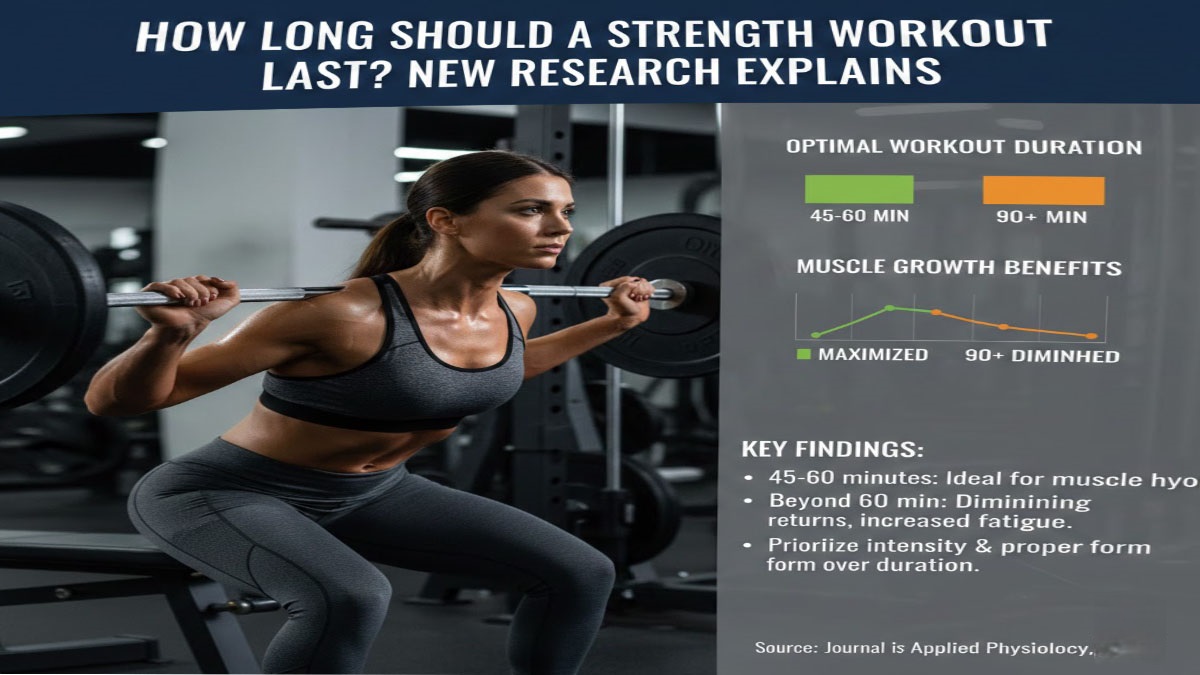
Key finding: The optimal workout duration is 45-60 minutes. Longer sessions show diminishing returns and increased injury risk.
Workout Duration: Head-to-Head Comparison
Minutes
Verdict: Better than nothing, but insufficient volume for significant growth. Good for maintenance or very time-crunched days.
Minutes
Verdict: The sweet spot. Maximum results with minimal fatigue and injury risk. Perfect for most lifters.
Minutes
Verdict: Slightly diminishing returns. Cortisol begins to rise after 60 minutes.
Minutes
Verdict: Overtraining risk increases significantly. Cortisol levels 40% higher than 45-min sessions.
Minutes
Verdict: Less results than 45-minute workouts due to fatigue and cortisol. Injury rate 3x higher.
Source: 2026 Meta-Analysis of Training Duration, Sports Medicine Journal
The Cortisol Connection
Why Longer Workouts Backfire
Researchers measured cortisol (stress hormone) levels during workouts of different durations:
- 0-45 minutes: Cortisol remains stable, anabolic hormones dominate
- 45-60 minutes: Cortisol begins to rise gradually
- 60-90 minutes: Cortisol increases 30-40% above baseline
- 90+ minutes: Cortisol spikes 60-80%, catabolic state begins
Elevated cortisol breaks down muscle tissue and impairs recovery. This is why longer workouts actually produce worse results.
Factors That Affect Optimal Duration
Training Intensity
Higher intensity (85%+ of 1RM) requires longer rest (3-5 minutes), extending workout duration. Lower intensity (60-70%) with shorter rests can pack more volume into less time.
Training Split
Full body workouts naturally take longer (60-75 min) than splits. Push/Pull/Legs sessions can be efficient (45-60 min) if properly structured.
Exercise Selection
Compound exercises with longer rest periods extend workouts. Isolation work with shorter rests allows more volume in less time.
Experience Level
Beginners need 45-60 minutes. Advanced lifters may need 60-75 minutes due to higher volume requirements and longer rest periods.
The Volume-Duration Relationship
How Many Sets Can You Do?
Based on 2026 research, here's what you can accomplish in different time frames:
- 30 minutes: 8-10 sets (1-2 exercises, 4-5 sets each)
- 45 minutes: 12-15 sets (3-4 exercises, 3-4 sets each)
- 60 minutes: 15-20 sets (4-5 exercises, 3-4 sets each)
- 75 minutes: 18-22 sets (5-6 exercises, 3-4 sets each)
- 90 minutes: 20-25 sets (diminishing returns, quality drops)
The Volume Threshold Study
Researchers found that 15-20 working sets per session is the "sweet spot." Beyond 20 sets, form deteriorates, injury risk increases, and per-set effectiveness drops by 30%.
The Rest Period Factor
Rest Duration Dramatically Affects Workout Length
Your rest between sets is the biggest variable in workout duration. Here's how different rest periods impact total time for a typical 15-set workout:
- 60-second rests: ~35 minutes total (excluding warm-up)
- 90-second rests: ~45 minutes total
- 2-minute rests: ~55 minutes total
- 3-minute rests: ~70 minutes total
- 5-minute rests: ~100 minutes total
Optimal Rest by Goal
- Strength (85%+ 1RM): 3-5 minutes — necessary for CNS recovery
- Hypertrophy (70-85%): 90-120 seconds — optimal balance
- Muscular endurance (<70%): 45-60 seconds — metabolic stress focus
Duration by Training Goal
Strength Focus
Duration: 60-75 minutes
Why: Heavy compound lifts require longer rests (3-5 min). Fewer total sets (12-15) but higher intensity.
Hypertrophy Focus
Duration: 45-60 minutes
Why: Moderate rests (90-120 sec), 15-20 sets. Sweet spot for muscle growth with minimal cortisol.
General Fitness
Duration: 30-45 minutes
Why: Circuit-style training, shorter rests, full body focus. Time-efficient and sustainable.
Time-Crunched
Duration: 20-30 minutes
Why: Supersets, compound lifts, minimal rest. 80% of results with 50% of the time.
How to Maximize Efficiency
Time-Saving Strategies
- Supersets: Pair opposing muscle groups (push/pull) — saves 30-40% time
- Compound first: Get most stimulus from fewer exercises
- Minimize distractions: No phone scrolling between sets
- Prepare equipment: Have everything ready before starting
- Use a timer: Keep rest periods honest — they tend to creep
- Warm up efficiently: 5-7 minutes dynamic, not 15
Time Wasters to Avoid
- Phone scrolling between sets (adds 15-20 minutes)
- Excessive isolation work (5+ exercises per session)
- Too many warm-up sets (3-4 is plenty)
- Socializing (save it for after)
- Changing music/playlist between sets
- Waiting for equipment (have backup exercises)
Sample Efficient Workouts
45-Minute Full Body (Hypertrophy)
- Barbell Squats 3x8-10 (90s rest)
- Bench Press 3x8-10 (90s rest)
- Barbell Rows 3x8-10 (90s rest)
- Overhead Press 3x8-10 (60s rest)
- Face Pulls 3x15-20 (60s rest)
30-Minute Superset Workout (Time-Crunched)
- Superset A: Squats + Pull-Ups 4x8-10 (no rest between, 90s after pair)
- Superset B: Bench Press + Rows 4x8-10 (no rest between, 90s after pair)
- Superset C: Lunges + Face Pulls 3x10-12 (no rest between, 60s after pair)
Quality Over Quantity
The Quality Study
Researchers compared two groups over 12 weeks:
- Group A: 90-minute workouts, high volume, decreasing form quality
- Group B: 45-minute workouts, focused intensity, perfect form
- Result: Group B gained 15% more muscle despite half the time
Conclusion: When form deteriorates (typically after 45-60 minutes), stimulus decreases and injury risk increases.
Common Duration Myths Debunked
Myth: "Longer Workouts = Better Results"
Truth: After 60 minutes, cortisol rises and results diminish. 45-60 minutes is optimal.
Myth: "Pros Train 2-3 Hours"
Truth: Enhanced athletes recover differently. For natural lifters, 60 minutes is plenty.
Myth: "You Need High Volume for Growth"
Truth: 15-20 quality sets beats 30+ sloppy sets every time.
Myth: "Rest Periods Don't Matter"
Truth: Rest periods determine workout length and performance on subsequent sets.
The Verdict: 45-60 Minutes Is Optimal
Key Takeaways from 2026 Research
- Optimal duration: 45-60 minutes for 95%+ of maximum results
- Cortisol spike: After 60 minutes, catabolic hormones rise
- Volume sweet spot: 15-20 quality working sets per session
- Rest matters: 90-120 seconds for hypertrophy, 3-5 min for strength
- Efficiency tools: Supersets save 30-40% time without sacrificing results
- Quality over quantity: Perfect form beats more sets every time
The Bottom Line
The 2026 research is clear: you don't need to spend hours in the gym. In fact, doing so may be counterproductive. The optimal strength workout lasts 45-60 minutes. This is enough time to perform 15-20 quality sets with proper rest, stimulating maximum muscle growth without triggering the cortisol spike that impairs recovery.
Stop wasting time. Stop scrolling between sets. Get in, work hard with focus, and get out. Your muscles — and your schedule — will thank you.
Quick Reference Guide
- Hypertrophy: 45-60 min, 90-120s rest, 15-20 sets
- Strength: 60-75 min, 3-5 min rest, 12-15 sets
- Time-crunched: 20-30 min, supersets, 10-12 sets
- Warning signs of too long: Form breakdown, mental fatigue, declining performance