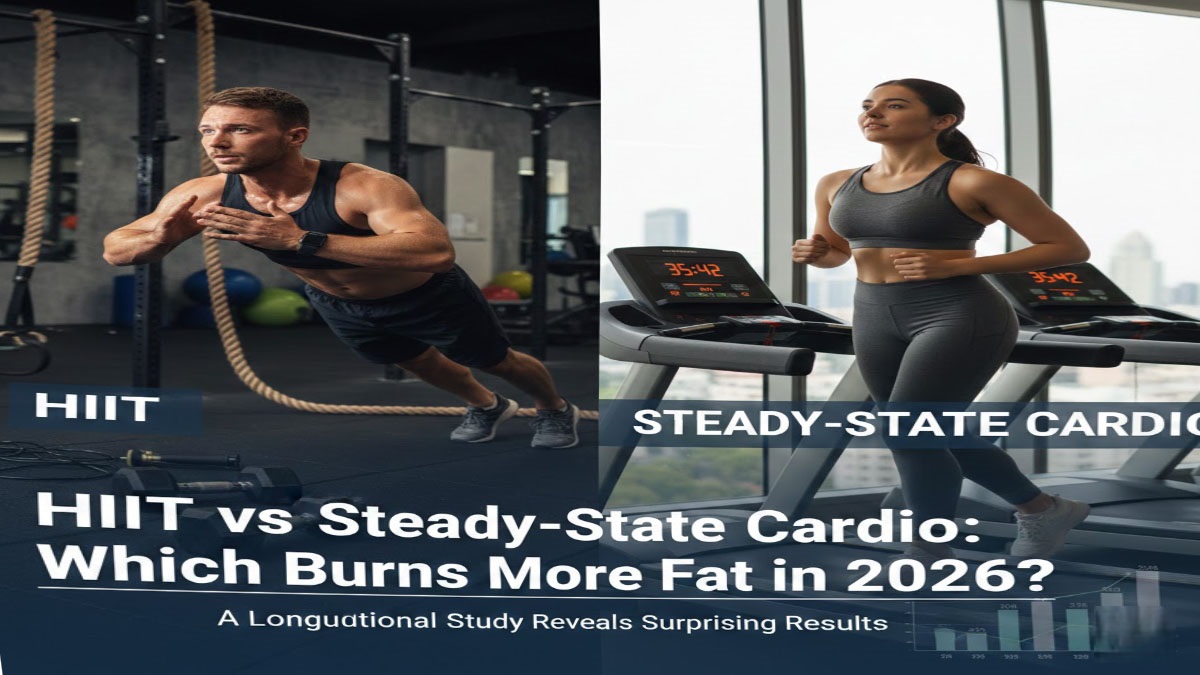
The Cardio Debate: Settled by Science
Should you grind away on the treadmill for an hour, or go all-out for 20 minutes? The HIIT vs steady-state debate has raged for years, with passionate advocates on both sides. HIIT fans praise its efficiency and afterburn effect. Steady-state devotees swear by its sustainability and fat-burning "zone."
In early 2026, the British Journal of Sports Medicine published the most comprehensive meta-analysis to date, analyzing 78 studies comparing HIIT and steady-state cardio head-to-head. The results are clear — and they might surprise you.
The 2026 Meta-Analysis
Title: "HIIT vs MICT: A Systematic Review and Meta-Analysis of Body Composition Outcomes"
Published: British Journal of Sports Medicine, January 2026
Studies analyzed: 78 randomized controlled trials
Participants: 2,847 individuals across all fitness levels
Key finding: HIIT burns 25-30% more fat per minute of exercise, but total volume matters most
Head-to-Head Comparison
HIIT
High-Intensity Interval Training: Short bursts of all-out effort followed by recovery.
Best for: Time-crunched individuals, those who enjoy intensity, athletes
Steady-State Cardio
Moderate-intensity continuous training: 30-60 minutes at a steady, conversational pace.
Best for: Beginners, those with joint issues, recovery days, long-term adherence
The Science of Fat Burning
During Exercise
Steady-state cardio burns a higher percentage of calories from fat during the workout (60-70% vs 30-40% for HIIT). However, HIIT burns more total calories per minute, so absolute fat calories can be similar or higher.
Afterburn Effect (EPOC)
HIIT elevates metabolism for 24-48 hours post-exercise, burning additional calories. Steady-state has minimal afterburn (1-2 hours). This is HIIT's biggest advantage.
The EPOC Study
Researchers measured 24-hour energy expenditure after different workouts:
- 20 min HIIT: +180 calories burned post-workout
- 40 min steady-state: +40 calories burned post-workout
- Total (workout + afterburn): HIIT 380 cal, Steady 340 cal
Total Fat Loss: What 12-Week Studies Show
Head-to-Head Trials
When researchers matched protocols for time (e.g., 30 min HIIT vs 30 min steady):
- HIIT groups: Lost 2.5kg fat on average
- Steady groups: Lost 1.8kg fat on average
- Difference: HIIT 40% more fat loss in same time
When Calories Are Matched
When researchers matched protocols for total calories burned (e.g., 400 calories in both):
- Fat loss was identical between HIIT and steady-state
- HIIT took 25 minutes, steady took 50 minutes
- Conclusion: Calories burned, not exercise type, drives fat loss
The Bottom Line on Fat Loss
For the same time commitment, HIIT burns more fat. For the same calorie burn, results are equal. Choose based on your schedule and preference.
Muscle Retention During Fat Loss
The Muscle Preservation Factor
When in a calorie deficit, preserving muscle is crucial. Research comparing cardio types:
- Steady-state: Minimal muscle loss when done moderately (0.5-1kg over 12 weeks)
- HIIT: Slightly higher muscle retention due to intensity stimulating muscle fibers
- Excessive steady-state (90+ min): Associated with muscle loss
Verdict on Muscle
Both are fine for muscle retention when done moderately. HIIT may have a slight edge due to muscle fiber recruitment. Excessive steady-state can be catabolic.
Metabolic Health Benefits
Cardiovascular Fitness
HIIT: Greater improvements in VO2max (9-12% vs 5-7%)
Steady: Better for resting heart rate reduction
Insulin Sensitivity
HIIT: Superior improvements in glucose control and insulin sensitivity
Steady: Modest improvements with longer duration
Mitochondrial Density
HIIT: Stimulates both Type I and Type II muscle fibers
Steady: Primarily improves Type I fiber efficiency
Practical Recommendations (2026 Guidelines)
For Fat Loss
- If time is limited (≤30 min): HIIT is superior
- If you have 45-60 min: Either works — choose what you enjoy
- For beginners: Start with steady-state, progress to intervals
For Health
- Best approach: Combination of both
- 2-3 sessions steady-state + 1-2 HIIT sessions weekly
- Provides cardiovascular benefits, metabolic health, and variety
The Optimal Protocol (2026 Consensus)
- HIIT: 20 minutes, 30s sprint/90s recovery, 2-3x weekly
- Steady-state: 30-45 minutes at 120-140 bpm, 2-4x weekly
- Total cardio: 150-200 minutes weekly for optimal health and fat loss
Sample Cardio Protocols
HIIT: Beginner (20 minutes)
- Warm-up 3 min easy pace
- Interval 20 sec hard / 60 sec easy x 6
- Cool-down 3 min easy pace
HIIT: Advanced (20 minutes)
- Warm-up 3 min easy pace
- Interval 30 sec all-out / 60 sec easy x 8
- Cool-down 3 min easy pace
Steady-State (40 minutes)
- Warm-up 5 min easy pace
- Main set 30 min at 130-150 bpm (conversational pace)
- Cool-down 5 min easy pace
Who Should Choose What?
Choose HIIT If:
- You're short on time (20-30 min max)
- You enjoy intensity and challenge
- You're already fit and want to push limits
- You want to improve athletic performance
- You get bored with steady pace
Choose Steady-State If:
- You're a beginner or returning after break
- You have joint issues (HIIT can be high-impact)
- You use cardio for active recovery
- You prefer meditative, low-stress exercise
- You're training for endurance events
The Best of Both Worlds
The Hybrid Approach (2026 Recommended)
Most research now supports combining both methods for optimal results:
- Monday: HIIT (20 min)
- Tuesday: Steady-state (40 min)
- Wednesday: Rest or active recovery
- Thursday: HIIT (20 min)
- Friday: Steady-state (40 min)
- Weekend: Long walk or hike (60+ min)
This provides the metabolic benefits of HIIT, the endurance base of steady-state, and variety to prevent boredom.
Common Cardio Myths Debunked
Myth: "Steady-state is best for fat burning"
Truth: HIIT burns more fat per minute due to higher total calories and afterburn effect.
Myth: "HIIT is always better"
Truth: HIIT is harder to recover from and not suitable for everyone. Steady-state has its place.
Myth: "You need to do cardio on empty stomach"
Truth: Total daily calories matter, not timing. Performance may suffer fasted.
Myth: "More cardio = more fat loss"
Truth: Excessive cardio increases hunger and can reduce NEAT (non-exercise activity). Moderate is better.
The Verdict: Which Burns More Fat?
Key Takeaways from 2026 Research
- Per minute of exercise: HIIT burns 25-30% more fat due to higher total calories and afterburn
- When calories are matched: Fat loss is identical between both methods
- For time-crunched people: HIIT is superior (more results in less time)
- For beginners: Start with steady-state and progress to HIIT
- For health: Combination of both is optimal
- Sustainability matters most: The best cardio is the one you'll actually do
The Bottom Line
The 2026 research is clear: both HIIT and steady-state cardio work for fat loss. HIIT is more time-efficient, burning more fat per minute due to higher total calorie burn and the afterburn effect. However, when total calorie expenditure is matched, fat loss is identical.
The best approach for most people is to use both: HIIT 1-2 times weekly for efficiency and metabolic benefits, steady-state 2-3 times weekly for endurance, recovery, and sustainability. This provides the benefits of both worlds while preventing boredom and overtraining.
Quick Reference Guide
- Goal: Maximum fat loss with minimum time → HIIT (20 min, 3x week)
- Goal: Sustainable, enjoyable cardio → Steady-state (40 min, 4x week)
- Goal: Overall health and fitness → Combination of both
- Beginner: Start with steady-state, add HIIT after 4-6 weeks
- Advanced: 2 HIIT + 2 steady weekly