The Great Stretching Debate
Should you stretch before or after a workout? For decades, we've been told to stretch before exercise to prevent injury. Then came studies showing static stretching before workouts might actually impair performance. So what's the truth?
In 2026, research has clarified the role of stretching timing. The answer isn't simple — it depends on the type of stretching, your goals, and what kind of workout you're doing. Here's what the latest science says.
The 2026 Research
Key finding: Static stretching before workouts can temporarily reduce strength and power. Dynamic stretching is better for warm-ups. Static stretching after workouts is effective for improving long-term flexibility without performance downsides.
Stretching Before vs After: Head-to-Head
Stretching Before Workout
Typically static stretching (holding a stretch) performed immediately before exercise.
- Increases short-term flexibility
- May feel good psychologically
- Can temporarily reduce strength and power (3-5%)
- Does not prevent injury (contrary to old beliefs)
- May impair performance in strength/power sports
Best for: Activities requiring flexibility (gymnastics, yoga, dance). Not recommended before strength training or running.
Stretching After Workout
Static stretching performed after exercise when muscles are warm.
- Improves long-term flexibility
- No negative impact on performance
- May reduce perceived muscle tightness
- Can be part of cool-down routine
- May improve range of motion for future workouts
- Does not significantly reduce soreness (DOMS)
Best for: Everyone. Optimal time to work on flexibility without performance trade-offs.
Dynamic vs Static Stretching: The Critical Difference
Dynamic Stretching
Moving while stretching: leg swings, arm circles, walking lunges, torso twists.
- ✅ Increases blood flow
- ✅ Activates muscles
- ✅ Improves range of motion
- ✅ Enhances performance
- ✅ Best for warm-ups
Static Stretching
Holding a stretch: touching toes, quad stretch, hamstring stretch.
- ✅ Improves long-term flexibility
- ✅ Best after workouts
- ⚠️ Can impair performance if done before
- ⚠️ Does not prevent injury before exercise
What 2026 Research Shows
Static Stretching Before Strength Training
Static stretching before lifting reduced maximal strength by 3-5% for up to 30 minutes. Dynamic stretching had no negative effect and improved performance.
Stretching and Injury Prevention
Meta-analysis of 30 studies found no evidence that pre-exercise stretching prevents injury. Warm-up (increased blood flow) does, but stretching alone doesn't.
Post-Workout Stretching and Flexibility
Regular post-workout stretching (3x weekly) significantly improved range of motion over 8 weeks with no negative effects on strength or hypertrophy.
Stretching and DOMS
Stretching before or after exercise does not reduce muscle soreness (DOMS). Active recovery is more effective for soreness reduction.
The Optimal Warm-Up (2026 Protocol)
5-10 Minute Warm-Up
- Light cardio: 3-5 minutes jogging, cycling, jumping jacks (increase heart rate, blood flow)
- Dynamic stretches: 3-5 minutes of leg swings, arm circles, walking lunges, torso twists (activate muscles, improve range of motion)
- Sport-specific movements: Light versions of exercises you'll do (bodyweight squats, light bench press)
Why This Works
Increases muscle temperature, improves nerve conduction, activates stabilizers, and prepares you mentally — all without the performance-decreasing effects of static stretching.
The Optimal Cool-Down (2026 Protocol)
5-10 Minute Cool-Down
- Light cardio: 3-5 minutes easy walking or cycling (gradually lower heart rate)
- Static stretching: 3-5 minutes holding stretches for major muscles worked (30 seconds each)
- Deep breathing: 1-2 minutes to relax nervous system
Why This Works
Static stretching when muscles are warm improves long-term flexibility without performance downsides. Helps transition to rest state, may reduce muscle tightness.
Flexibility Training: How Often and How Long
Frequency
2-3 times weekly minimum for flexibility gains. Daily is fine if done after workouts.
Duration
Hold each stretch 30-60 seconds. 2-4 rounds per muscle group.
Intensity
Mild discomfort, not pain. You should feel tension, not sharp pain.
Timing
After workouts when muscles are warm, or standalone sessions after light warm-up.
Common Stretching Myths Debunked
Myth: "Stretching before exercise prevents injury"
Truth: No evidence. Warm-up prevents injury, not stretching. Static stretching may even increase injury risk by temporarily weakening muscles.
Myth: "Always stretch to warm up"
Truth: Static stretching is NOT a warm-up. It doesn't increase heart rate or blood flow. Dynamic movement is the real warm-up.
Myth: "Stretching reduces muscle soreness"
Truth: Multiple studies show stretching doesn't reduce DOMS. Active recovery (walking, light movement) is more effective.
Myth: "You must stretch every day to be flexible"
Truth: 2-3 times weekly is enough for most people. Consistency matters more than frequency.
When Static Stretching Before Workout Makes Sense
Exceptions to the Rule
- Flexibility-focused activities: Gymnastics, yoga, dance — where extreme range of motion is required
- Very tight individuals: If you're extremely inflexible, light static stretching before may help, but dynamic still preferred
- Rehabilitation: Under professional guidance, specific static stretches may be prescribed
Practical Stretching Guide
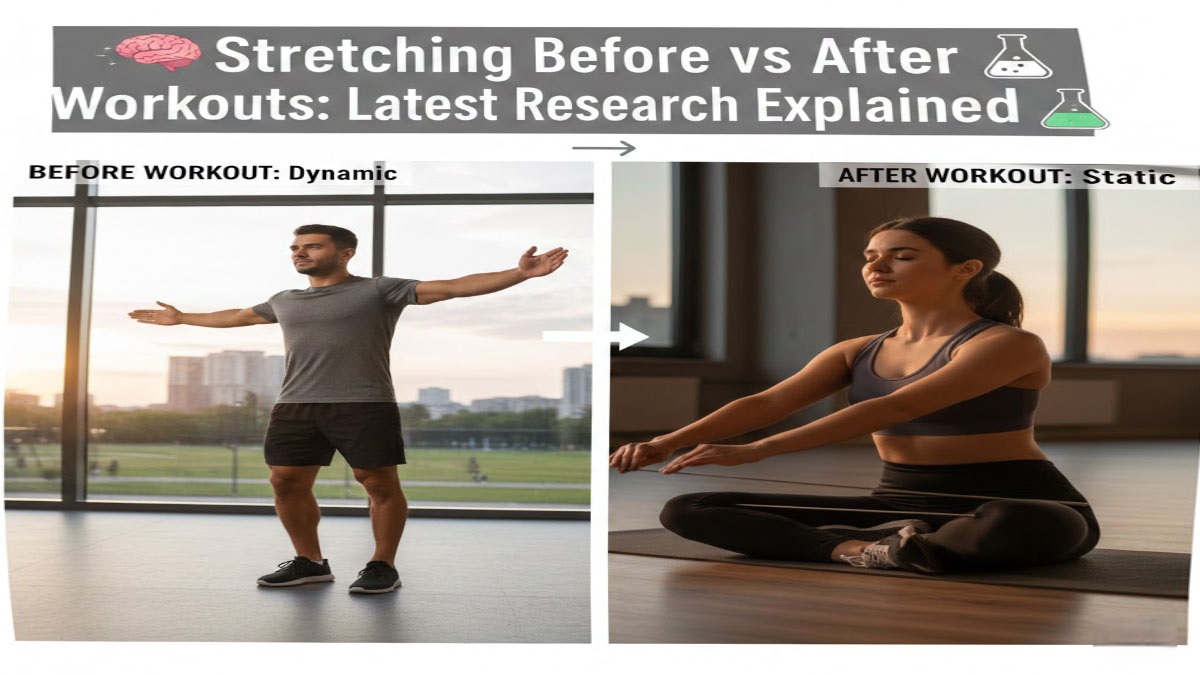
Before Workout (Dynamic)
- Leg swings (forward/side)
- Arm circles
- Walking lunges
- Torso twists
- Cat-cow stretch
- Hip circles
After Workout (Static)
- Hamstring stretch
- Quad stretch
- Chest stretch
- Triceps stretch
- Glute stretch
- Child's pose
Stretching Tips for Best Results
Do
- Breathe deeply while stretching
- Hold static stretches 30-60 seconds
- Stretch to mild tension, not pain
- Stretch warm muscles (after workout)
- Be consistent (2-3x weekly)
Don't
- Bounce while stretching (ballistic)
- Hold breath
- Stretch cold muscles
- Stretch to sharp pain
- Rely on stretching for warm-up
The Verdict: Time It Right
Key Takeaways from 2026 Research
- Before workout: Dynamic stretching only. Static stretching can impair strength and power.
- After workout: Static stretching ideal for long-term flexibility gains.
- Warm-up properly: Light cardio + dynamic movement, not static stretching.
- Stretching doesn't prevent injury — proper warm-up does.
- Stretching doesn't reduce soreness — active recovery does.
- Consistency matters: 2-3 times weekly for flexibility.
The Bottom Line
The 2026 research is clear: when you stretch matters. Save static stretching for after workouts when muscles are warm. Use dynamic movement to warm up. This simple timing change can improve your performance, prevent unnecessary weakness before lifting, and still give you the flexibility benefits you want.
Quick Reference: When to Stretch
- ✅ Before workout → Dynamic stretching only
- ✅ After workout → Static stretching (hold)
- ✅ On rest days → Static stretching (after light warm-up)
- ❌ Before workout → Static stretching (avoid)
- ❌ Cold muscles → Static stretching (avoid)