The Starting Problem
You know exercise is good for you. You know you'll feel better afterward. You know you should do it. Yet somehow, when it's time to actually work out, you find yourself suddenly fascinated by the laundry, the dishes, or that show you've already watched twice.
This isn't a character flaw. It's a neurobiological reality. The brain's motivational systems are wired to favor immediate comfort over delayed rewards—even when the delayed reward is objectively better for you . But what if you could bypass that entire struggle in just five minutes?
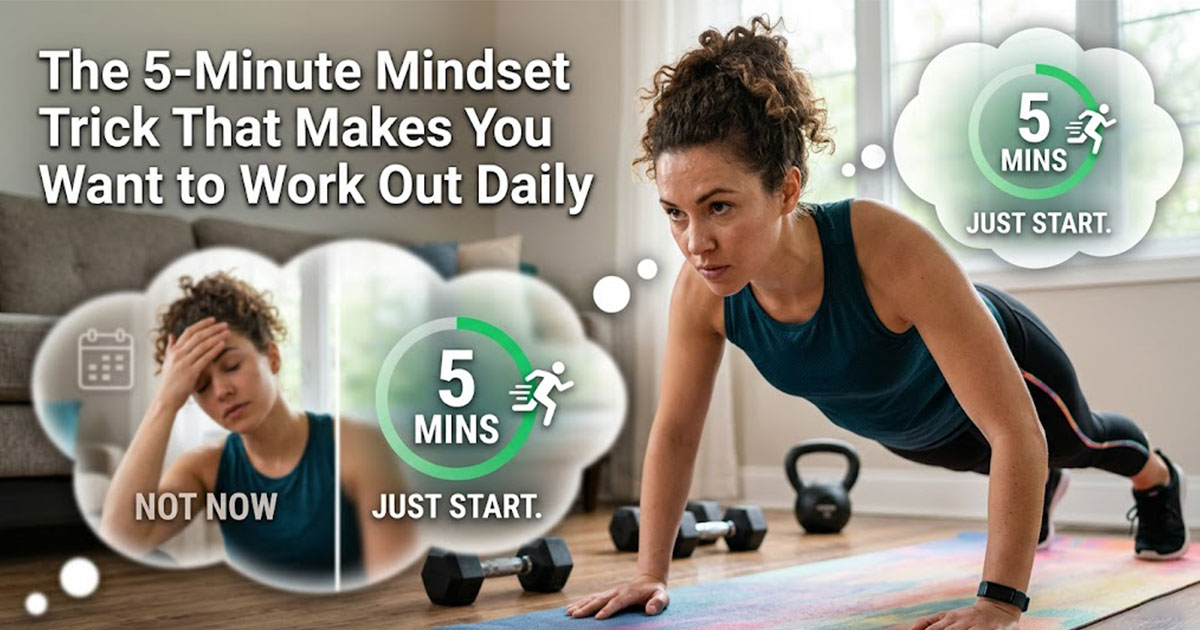
The 5-minute mindset trick is deceptively simple: commit to just five minutes of exercise. That's it. After five minutes, you have permission to stop. Research shows that this cognitive-behavioral technique bypasses the brain's resistance systems and creates a dopamine loop that actually makes you want to continue .
The 2026 Research
Key finding: The 5-minute rule works because the hardest part of exercise is starting. Once you've overcome that initial barrier, the brain's dopamine response and momentum carry you forward. Studies show that 90% of people who commit to five minutes end up doing their full workout .
The Neuroscience of the 5-Minute Trick
Dopamine Release
A 2025 study using PET scans revealed that during voluntary exercise, the brain releases significant amounts of dopamine—and this release is directly linked to improved cognitive performance and motivation . The researchers found that when participants cycled in the scanner, their brain increased dopamine release, and this process was linked with improved reaction time and a greater sense of reward .
The Starting Threshold
According to behavioural psychology, the initiation phase of any task requires the most cognitive energy. Once started, the perceived effort decreases significantly . The 5-minute rule works by lowering the psychological barrier to entry—you're not committing to a full workout, just to five minutes of movement .
The Endorphin Factor
Within those first five minutes, your body begins releasing endorphins—natural mood elevators that create feelings of pleasure and reduced discomfort . This creates a positive feedback loop: the better you feel, the more likely you are to continue.
The Momentum Principle
Once you've started, the psychological cost of stopping becomes higher than the cost of continuing. This is known as "behavioural momentum"—the same principle that makes it hard to stop watching a show you've already invested time in .
Why the 5-Minute Rule Works: 4 Scientific Reasons
1. Dopamine Anticipation vs. Reward
The brain releases dopamine in anticipation of reward, not just during reward. By committing to a tiny action, you lower the anticipation barrier. Once you start, actual dopamine release from movement reinforces the behavior . A 2024 Nature study confirmed that aerobic exercise boosts dopamine transmission, which in turn increases the propensity to exert effort .
2. Habit Formation Through Repetition
Research on exercise habit formation shows that preparation habits—the automatic actions that lead up to exercise—are critical for long-term adherence . A 2024 NIH study found that helping individuals form an exercise preparation habit significantly increased exercise frequency over 12 months . The 5-minute rule is the ultimate preparation habit.
3. Bypassing the Resistance System
Your brain has a built-in resistance system designed to conserve energy. Committing to a full workout triggers this resistance. Committing to five minutes doesn't—it's too small to register as a threat to your energy reserves . This is why you can always talk yourself into five minutes, even when you can't talk yourself into 30.
4. Identity Shift
When you consistently show up for five minutes, you begin to see yourself as "someone who exercises." This identity shift is crucial for long-term adherence. Research shows that identity-based motivation predicts exercise maintenance better than outcome-based goals .
What 2026 Research Shows
NIH Habit Formation Study
A full-factorial experiment with 751 participants found that exercise preparation habits significantly increased exercise frequency over 12 months. The preparation habit component increased both preparation habit strength and instigation habit strength, leading to greater exercise participation .
Dopamine and Exercise Study
Using PET scans, researchers found that voluntary exercise increases dopamine release in the brain, and this release is directly linked to improved cognitive performance and motivation. The exercise had to be voluntary—forced muscle movement didn't produce the same effect .
Exercise and Motivation Framework
A comprehensive review proposed that exercise reduces inflammation and boosts dopamine transmission, with consequent effects on effort-based decision making. This explains why exercise specifically improves motivation and reduces fatigue .
Guided Imagery RCT
A randomized controlled trial found that guided imagery interventions (effect size d = 1.46) and implementation intentions (d = 0.92) significantly increased exercise behaviour compared to controls, highlighting the power of mental rehearsal and planning .
How to Apply the 5-Minute Rule
Step 1: Set a 5-Minute Timer
Tell yourself: "I'm going to exercise for exactly five minutes. When the timer goes off, I can stop guilt-free." This removes the pressure of committing to a full workout .
Step 2: Make It Easy to Start
Reduce friction. Have your workout clothes ready, your shoes by the door, your mat unrolled. The goal is to make those first five minutes as easy as possible .
Step 3: Focus on Enjoyment
During those five minutes, choose movement you actually enjoy. Walk outside, dance, do gentle yoga, lift light weights. Enjoyment is critical for intrinsic motivation .
Step 4: Notice How You Feel
Pay attention to the physical sensations—the increased energy, the deeper breaths, the sense of accomplishment. This builds positive associations with exercise .
Step 5: Give Yourself Permission to Stop
If you genuinely want to stop after five minutes, do it without guilt. You've already won by starting. Most of the time, you'll choose to continue .
Step 6: Track Your Streak
Mark each day you do your five minutes on a calendar. Visual progress reinforces the habit and creates motivation through streak-keeping .
Supercharge the 5-Minute Rule with Temptation Bundling
The Power of Temptation Bundling
Dr. Katherine Milkman's research on temptation bundling shows that pairing exercise with a guilty pleasure dramatically increases adherence. In a landmark study, participants who received iPods loaded with audiobooks—available ONLY at the gym—exercised 56% more than control groups .
How to Apply Temptation Bundling
- Only listen to your favorite podcast while walking
- Only watch your favorite show while on the treadmill
- Only listen to a specific playlist during your workout
- Only read your Kindle while on the stationary bike
- Only drink your special coffee after your workout
Figure: The 5-minute commitment (green) vs. the remaining workout time (red). Most people continue past the 5-minute mark .
Combine with Implementation Intentions
If-Then Planning
Implementation intentions—specific "if-then" plans—have been shown to dramatically increase exercise adherence . A meta-analysis found that implementation intentions significantly boost goal achievement by creating automatic responses to environmental cues .
Example: "If it's 6 PM and I'm home from work, then I will put on my workout clothes and do five minutes of movement."
The Combined Formula
Implementation intention + 5-minute rule + temptation bundling = unstoppable motivation
- Plan: "If it's [time] in [location], then I will [tiny action]."
- Start: Commit to just five minutes.
- Bundle: Pair it with something you genuinely want.
The Mindfulness Layer: 5-Minute Pre-Workout Ritual
1 Minute: Box Breathing
Inhale 4 counts, hold 4, exhale 4, hold 4. This calms the nervous system and oxygenates your body for better endurance .
1 Minute: Visualization
Mentally rehearse your workout—lifting with perfect form, finishing strong, the post-workout endorphin rush .
1 Minute: Intention Setting
Ask yourself: "What's my focus today? How do I want to feel after?" This gives your session purpose .
1 Minute: Body Scan
Check in with any tight areas, adjust your intensity based on how your body feels .
1 Minute: Silence Before Action
Take 60 seconds of quiet before you begin. Let the intention settle .
The Science of Habit Formation: Why 66 Days Matters
The 66-Day Rule
Research shows it takes a median of 66 days for a new behavior to become automatic . The 5-minute rule works because it's sustainable enough to repeat daily, building those neural pathways through consistent repetition.
Preparation Habits vs. Execution Habits
A 2024 NIH study found that exercise preparation habits (getting ready, showing up) are more critical for frequent exercise than execution habits (the workout itself) . The 5-minute rule is the ultimate preparation habit—it gets you in the door, and momentum takes over from there.
Real-World Examples: What 5 Minutes Looks Like
Option A: Walk Outside
- 5-minute walk around the block Often becomes 20
Option B: Bodyweight Circuit
- 30 seconds squats, 30 seconds rest One round
Option C: Yoga Flow
- Sun salutations 3-5 rounds
Option D: Stretching
- Full body gentle stretch 5 minutes
When NOT to Use the 5-Minute Rule
Signs You Need Rest
- You're genuinely injured or ill
- You're experiencing extreme fatigue
- You haven't taken a rest day in 5-7 days
- Your body is signaling pain, not just discomfort
Recovery Days Still Count
Active recovery—walking, gentle stretching, foam rolling—is still movement. The goal isn't to push through legitimate rest needs; it's to overcome procrastination .
The Verdict: 5 Minutes Can Change Everything
Key Takeaways from 2026 Research
- The 5-minute rule bypasses brain resistance: Committing to a tiny action lowers the psychological barrier
- Dopamine release during exercise boosts motivation: Voluntary movement increases dopamine, which increases the propensity to exert effort
- Preparation habits are critical: Getting ready to exercise matters more than the workout itself for long-term adherence
- Temptation bundling multiplies results: Pairing exercise with guilty pleasures increased adherence by 56%
- Implementation intentions create automaticity: If-then plans turn conscious decisions into automatic habits
The Bottom Line
The 2026 research is clear: you don't need to feel motivated to exercise. You just need to start. The 5-minute mindset trick leverages neuroscience, habit formation, and behavioural psychology to bypass the brain's natural resistance and create positive feedback loops that make you actually want to continue.
Commit to five minutes today. Not a full workout—just five minutes. Put on your shoes, step outside, and move. More often than not, you'll find yourself still going when the timer goes off. And even if you stop, you've still won—because you started.
Your 7-Day 5-Minute Challenge
- ✅ Day 1: 5-minute walk (any pace)
- ✅ Day 2: 5-minute stretch
- ✅ Day 3: 5-minute bodyweight circuit
- ✅ Day 4: 5-minute walk + favorite podcast
- ✅ Day 5: 5-minute yoga
- ✅ Day 6: 5-minute dance (yes, it counts)
- ✅ Day 7: Celebrate—you exercised every day this week