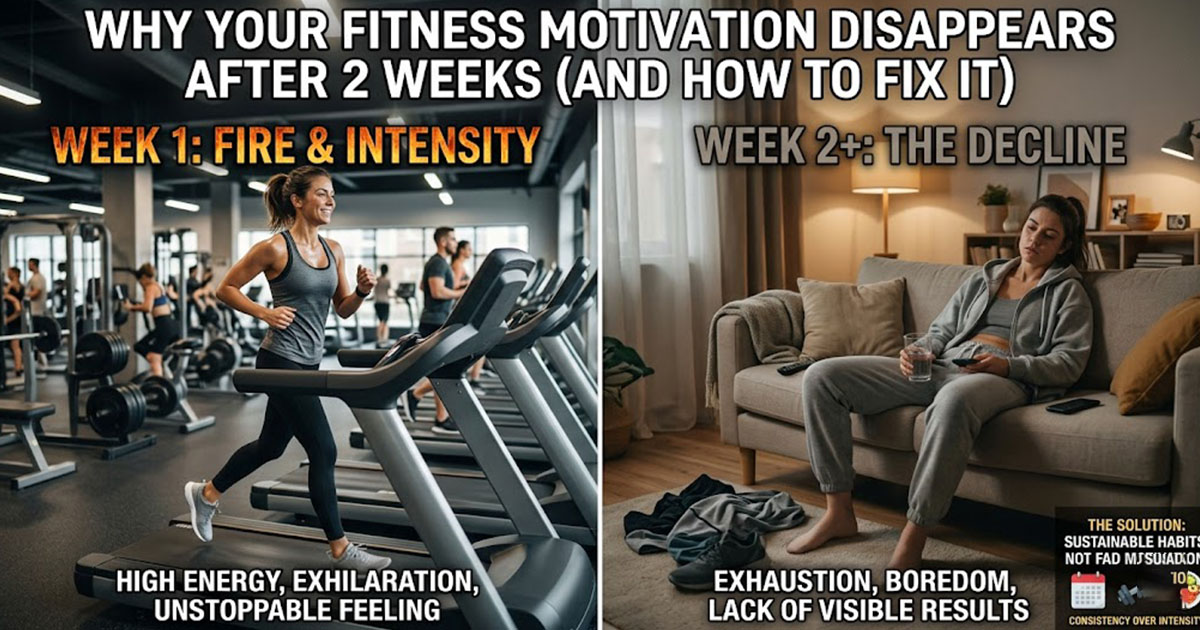
The Two-Week Wall
You start the year—or any Monday—with fire in your veins. You're going to train six days a week, eat perfectly, and finally get in shape. Week one is great. Week two is harder. By week three, you've missed two workouts. By week four, you're back where you started, wondering why you can't stick with anything.
This isn't a personal failure. It's a predictable outcome of human psychology colliding with poorly designed plans. Strava's analysis of over 800 million activity logs reveals a phenomenon they call "Quitter's Day"—the second Friday in January, when more people abandon their fitness resolutions than any other day . Studies consistently report that 80-92% of resolutions fail by February, with most crumbling within the first two weeks .
But why does motivation evaporate so predictably? And more importantly, how can you build a fitness routine that survives beyond the two-week wall? The 2026 research points to clear answers.
The Numbers: How Bad Is It?
"Quitter's Day" isn't a myth—it's a statistical reality. Strava's data shows a sharp drop in exercise tracking by mid-January that's remarkably consistent year after year .
The Neuroscience of Motivation: Why It Always Fades
Motivation isn't a character flaw or a resource you can summon at will. It's a neurobiological process—and understanding how it works explains why relying on it is a losing strategy.
Dopamine and the Anticipation Problem
The brain releases dopamine in anticipation of reward, not just when the reward occurs. When you start a new fitness program, the novelty triggers high dopamine release. You feel excited, energized, unstoppable .
But as the behavior becomes familiar, dopamine response drops—even if your effort remains high . This is why the second week feels harder than the first, even though nothing has changed physiologically. Your brain is no longer getting the same chemical payoff.
Motivation Is State-Dependent
Psychological research consistently shows that motivation is state-dependent—it fluctuates based on environment, stress, sleep, and reward expectancy . Waiting to feel motivated before training is like waiting for the perfect weather to go outside. It's unreliable by nature .
The 2026 Consensus
"Motivation is not a constant trait—it's an emotional state that naturally rises and falls. When your plan depends on feeling inspired every day, it's bound to fail the moment life gets stressful, busy, or exhausting."
The Fresh Start Effect Fades
The "fresh start effect" (temporal landmarks like New Year's or Mondays) boosts initial enthusiasm through psychological priming . But without reinforcement, dopamine-driven novelty fades, leading to the predictable mid-January crash . This creates a vicious cycle of guilt and gym anxiety, where 23% quit by Quitter's Day and 43% by month's end .
5 Reasons Your Motivation Disappears (Backed by Science)
1. Unrealistic Expectations
People aim for drastic changes like "gym every day" or "lose 20 pounds in a month," ignoring that sustainable progress requires gradual adaptation. Research shows aggressive goals lead to burnout, with 35% of failed resolvers citing unrealistic targets as the primary cause . Your body doesn't care about your arbitrary timeline—it follows biological laws that can't be rushed without consequences.
2. No Systems, Only Motivation
Without structured routines, life disruptions—work stress, illness, or travel—derail efforts. Adherence drops 61% after just one missed day . Motivation is a feeling; systems are infrastructure. When the feeling fades, which it always does, only infrastructure remains .
3. Outcome Obsession
Focusing solely on outcomes like weight loss or muscle gain backfires when results don't appear quickly. Progress in training is rarely linear, and the brain is poorly wired to stay motivated when rewards are delayed . When results slow, motivation collapses .
4. No Backup Plan
When people miss one workout, they often give up entirely because their plan doesn't account for disruptions . Life is unpredictable. Work deadlines, family obligations, illness, and travel will happen. Without a backup plan, one missed day becomes two, then ten, then "I'll start again Monday."
5. You Hate Your Workouts
If you hate your workouts, quitting is only a matter of time . Many people force themselves into routines they believe they "should" do rather than ones they actually enjoy. Enjoyment predicts adherence more strongly than outcomes .
The Science of Habit Formation
Habit formation is neuroscience, not willpower. The basal ganglia—your brain's habit center—strengthens neural pathways through repeated cue-behavior-reward loops, making actions automatic over time . This isn't motivational theory; it's observable brain architecture changing through repetition.
The 66-Day Rule
The famous "66-day habit threshold" comes from research where it took a median of 66 days for behaviors like eating fruit or exercising to become habitual, with ranges from 18 to 254 days depending on complexity . Simple habits form faster. Complex routines take longer. But all habits follow the same neurological pattern: repetition creates automation.
This explains why the first two weeks are so dangerous. You're in the "novelty phase"—dopamine is high, but habits haven't formed yet. By week three, dopamine drops, and if habits aren't in place, motivation collapses .
Intrinsic vs Extrinsic Motivation
Intrinsic motivation comes from enjoyment and personal meaning. Extrinsic motivation comes from outcomes like appearance, numbers, or praise. Studies show that intrinsic motivation predicts long-term exercise adherence far better than extrinsic goals .
When progress slows, extrinsic rewards weaken. If training has no intrinsic value, adherence collapses. This is why people who exercise because they love it stick with it for decades, while those exercising only for looks quit when results plateau .
The Identity Shift: From Doing to Being
Identity-Based Motivation
People who view training as part of who they are—not something they do—are more consistent over time. Identity-based motivation research shows that behaviors aligned with self-concept require less conscious effort . Instead of asking "Do I feel motivated today?", the better question is "What would someone who trains regularly do today?"
This shift transforms exercise from a chore into an expression of identity. When you're "someone who trains," missing a workout feels like a betrayal of self, not just breaking a promise to yourself.
The Motivation Timeline: What Happens When
High dopamine, fresh start effect, strong motivation. Risk: doing too much too soon. Unrealistic expectations set the stage for failure .
Dopamine drops, novelty wears off, motivation starts to wane. First missed workouts occur. Adherence drops 61% after one missed day .
23% quit by "Quitter's Day" (second Friday in January). By month's end, 43% have abandoned their resolutions .
Median time for behaviors to become automatic. Those who survive this long have built neural pathways that make exercise feel "wrong" to miss .
What 2026 Research Reveals
State-Based Motivation Study
Research confirms that tracking motivation states and using state-based interventions improves exercise adherence. Motivation fluctuates predictably—planning for these fluctuations increases consistency .
Body Satisfaction and Activity
A 2026 study published in BMC Public Health found that body satisfaction and health evaluation create dual-motivational pathways that affect physical activity. How you feel about your body directly impacts your motivation to move it .
Epigenetic Plasticity
Groundbreaking 2026 research suggests that training variability may influence epigenetic markers related to motivation and resilience. This means consistent, varied training might actually rewire your brain's motivational systems at a molecular level .
How to Fix It: Science-Backed Strategies
1. Start Embarrassingly Small
On low-energy days, people often skip workouts entirely because they feel they can't perform at their best . Set a minimum standard—something so easy you can do it even on your worst days. This could be a five-minute walk, light stretching, or one exercise. Keeping the habit alive matters more than intensity .
2. Build Systems, Not Motivation
Schedule workouts at the same time, tie them to existing routines, and create non-negotiable habits . Consistency comes from structure, not inspiration . The gym will empty by mid-January, but you'll still be there—not through willpower but through systems that make quitting harder than continuing .
3. Track Process, Not Outcomes
Shift your focus to habit-building. Measure success by how consistently you show up rather than how your body looks . Track workouts completed, steps taken, or days you stayed active. These metrics are fully within your control and reinforce consistency .
4. Create Backup Plans
Have flexible options ready. A short home workout, a walking routine, or a low-effort alternative for busy days . The goal is to keep the habit alive, even when conditions aren't ideal. Never miss twice—one missed workout is fine, but two in a row starts a new habit .
5. Find Enjoyment
Choose activities you genuinely like—or at least don't dread . Strength training, walking, cycling, swimming, yoga, or sports all count as exercise. Enjoyment increases consistency far more than intensity does .
6. Practice Self-Compassion
Missing a workout isn't failure—it's part of the process . Harsh self-criticism reduces motivation and increases dropout risk. Self-compassion has been linked to better exercise adherence and resilience during setbacks .
7. Rotate Your Goals
Switching focus from max strength to hypertrophy, technique, or conditioning can restore engagement while maintaining progress . Variation prevents mental stagnation without abandoning consistency .
8. Use the "Habit of Starting"
Dr. Phillippa Lally, a habit researcher, recommends focusing on the habit of initiating exercise first. "If someone can think about where in their lives they would like to have a physical activity habit (e.g., first thing in the morning), then on the first day they could just get up and start the session even if what they actually do is very little, e.g., go for a walk, or do 5 minutes Pilates. Then they need to keep doing this, but slowly increase the activity they do. Every time they start they are forming the habit, so it's a win" .
Your 8-Week Sustainability Plan
Weeks 1-2: Foundation (Build the habit of starting)
- Frequency 3 sessions weekly, any length
- Intensity Conversational pace, "embarrassingly easy"
- Goal Show up, nothing more
Weeks 3-4: Consistency (Weather the dopamine drop)
- Frequency 3-4 sessions weekly, 20-30 min
- Strategy Use backup plans, never miss twice
- Goal Build momentum through repetition
Weeks 5-8: Integration (Approaching habit)
- Frequency 3-4 sessions weekly, 30-45 min
- Focus Enjoyment, identity shift
- Goal Exercise feels normal, missing feels wrong
The Cost of Quitting: What You Lose
How Fast You Lose Fitness
- Aerobic fitness: Drops can start after 1-2 weeks of total rest, with significant loss after 3-4 weeks of no activity
- Strength: Relatively small drop after 2 weeks, but approximately 70% drop after 3 months
- Flexibility: Obvious decrease in suppleness after 1-2 weeks of no work
- Muscle mass: Visible drops in muscle mass can be apparent much sooner than strength loss
Every time you quit and restart, you're not just losing time—you're losing accumulated adaptations. Consistency, even at lower intensity, preserves progress .
The Bottom Line: Motivation Follows Action
Key Takeaways from 2026 Research
- Motivation is unreliable: 80-92% of resolutions fail, most within weeks
- Dopamine drops predictably: The two-week wall is neurobiological, not personal failure
- Habits take 66+ days: You're not supposed to feel motivated yet
- Systems beat motivation: Schedule, backup plans, and minimum standards keep you going
- Identity matters: "I'm someone who trains" beats "I'm trying to get fit"
- Self-compassion works: One missed workout doesn't matter—two in a row does
The Truth
The 2026 research is clear: motivation disappearing after two weeks isn't a sign of weakness—it's a sign that you're human. The people who stick with fitness long-term aren't more motivated than you. They've built systems, habits, and identities that carry them through the days when motivation is nowhere to be found .
Research consistently shows that action precedes motivation more often than the reverse . Showing up creates motivation, not the other way around. Start small, build systems, forgive yourself, and keep showing up. By day 66, you won't need motivation—you'll have habit.
Your First Step Today
- ✅ Set a minimum standard (5 min walk, one exercise)
- ✅ Schedule your next three sessions now
- ✅ Create one backup plan for busy days
- ✅ Forgive last week's missed workouts
- ✅ Start today—not Monday