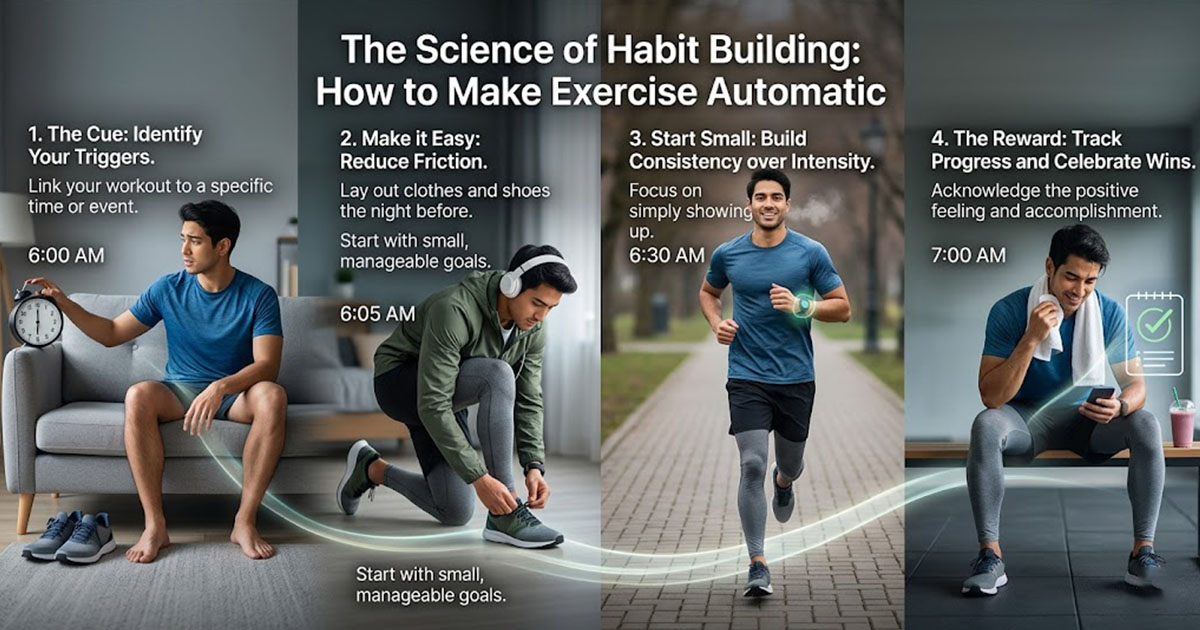
The Holy Grail of Fitness
Imagine a version of yourself who doesn't negotiate with the alarm clock. Who doesn't debate whether to go to the gym. Who simply puts on shoes and moves, the same way you brush your teeth without thinking. This isn't willpower—it's automaticity. It's the holy grail of fitness, and in 2026, neuroscience has finally mapped exactly how it works .
For decades, we've treated exercise as a battle of wills. We've relied on motivation, discipline, and "just doing it." But the latest research reveals a completely different path: one where exercise becomes as automatic as tying your shoes, triggered by cues you've hardwired into your brain's deepest structures .
This isn't motivational fluff. It's neurobiology. And understanding it is the key to making fitness last for life.
The 2026 Research
Key finding: Habits are physically stored in the dorsolateral striatum (DLS) of your brain. Once a motor sequence is learned, it can operate independently of the cortex—meaning you can perform it without conscious thought. This is why established habits feel automatic .
The Neuroscience of Habits: How Your Brain Rewires Itself
Recent findings from multiple independent laboratories have revolutionized our understanding of how motor habits are formed and stored. The key player is a region of the brain called the dorsolateral striatum (DLS) .
The Dorsolateral Striatum (DLS)
The DLS plays a crucial role in the formation of learned motor behaviors that eventually become stereotyped and are often referred to as habits . Research shows that while the motor cortex is essential during the learning phase, once the motor behavior is learned, inactivation of the cortex does not impair the motor action—it continues to be performed flawlessly .
When researchers injected a substance called ZIP into the DLS that reverses synaptic potentiation, the learned behavior was permanently blocked. However, injections into the dorsomedial striatum or motor cortex had no effect in expert subjects . This proves that after learning, the motor program is actually stored in the DLS, not the cortex.
The DLS-SNr-PF-DLS Loop
Researchers have discovered a highly precise spatial organization within the basal ganglia. The DLS connects to the substantia nigra pars reticulata (SNr), which connects to the parafascicular nucleus (PF) of the thalamus, which then projects back to the DLS . This loop is subdivided into many parallel loops representing different body regions—forelimbs, trunk, hindlimbs, and facial areas .
When a group of DLS neurons is activated, the corresponding SNr neurons are silenced, disinhibiting the thalamostriatal PF neurons, which then excite their target DLS neurons, reinforcing the original activity . This feedback loop strengthens each time the motor sequence is performed successfully, especially when rewarded through a dopamine burst .
Long-Term Potentiation
The projections from the motor cortex to the striatum undergo synaptic plasticity during motor learning, as do projections from the thalamus . The researchers propose that these parallel loops act to reinforce the activity of the different striatal projection neurons, and that synaptic transmission in the DLS becomes potentiated each time the motor sequence is performed successfully, if rewarded through a dopamine burst .
After learning, the DLS-SNr-PF-DLS loop can operate in isolation, meaning the behavior can run automatically without cortical input . This is the physical basis of automaticity.
What Is a Habit, Really?
According to recent research published in Communications Psychology, habit can be understood as "a cognitive representation of a cue-behavior association, acquired through repetition of the behavior in the presence of the cue" . Once established, a habit, in turn, promotes the likelihood of repeated execution of the behavior by automatically instigating the associated behavior when the cue occurs .
In simpler terms: a habit is when a specific cue automatically triggers a specific behavior, without requiring conscious thought or motivation. This is measured by researchers using the Self-Report Behavioral Automaticity Index, which assesses how automatic a behavior feels .
Key Components of Habit
- Cue: A trigger that initiates the behavior (time of day, location, preceding action)
- Behavior: The action itself (putting on shoes, walking, gym entry)
- Reward: Positive reinforcement (dopamine burst) that strengthens the association
- Repetition: Repeated co-activation of the cue-behavior-reward loop
- Automaticity: The point where the behavior can run without conscious thought
The Role of Repetition: Cue-Behavior Pairing
Cue-behavior repetition plays a key role in the habit formation process, serving as both an antecedent and an outcome of habit formation . The HabitWalk study, a micro-randomized trial published in 2024, examined this relationship directly .
HabitWalk Study Findings
This 105-day study with 24 participants found a positive effect of cue-behavior repetition on habit strength. In other words, every time you successfully perform your exercise in response to its cue, you strengthen the habit .
The researchers measured habit strength daily using the Self-Report Behavioral Automaticity Index and tracked actual behavior via activity trackers. Their multilevel models confirmed that repetition drives automaticity .
Habit Formation Trajectory
Existing findings suggest that habit formation typically follows a non-linear pattern, often characterized by asymptotic growth, where initial rapid progress gradually slows and plateaus .
However, the HabitWalk study found that person-specific habit trajectories were "highly idiosyncratic"—meaning everyone's path looks different. This is why personalized approaches matter .
Habit Degradation Study
A brand new study published just weeks ago tested strategies for degrading unhealthy habits. The researchers found that habit strength declined over time across all groups, with steeper reductions during the first week of intervention .
Critically, they found that using habit degradation strategies (like substitution, inhibition, and reduced accessibility) may accelerate early reductions in habit strength . This suggests the same principles work in reverse for building good habits.
Exercise Automaticity Predictors
A prospective study over 2 weeks with 406 participants found that—controlling for past behavior—perceived behavioral control, affect (how you feel about exercise), and action planning were significant and positive predictors of exercise automaticity .
This means that how you feel about exercise and whether you plan when to do it directly predict how automatic it becomes .
What Predicts Automaticity? The 2026 View
Affect (How You Feel)
Research confirms that positive affect during exercise predicts automaticity. If it feels good, you're more likely to repeat it until it becomes automatic . This aligns with research showing that enjoyable exercise boosts dopamine levels, increasing motivation and reinforcing the habit .
Action Planning
Planning when and where you'll exercise—implementation intentions—directly predicts automaticity . The study found a significant interaction between perceived behavioral control and planning: planning became less predictive of automaticity at higher levels of control, suggesting these factors work together .
Perceived Behavioral Control
How much control you feel over your exercise behavior directly predicts automaticity . This is why removing barriers and making exercise easy is so critical for habit formation.
Past Behavior
Past behavior is necessary but not sufficient. The research shows that even controlling for past behavior, the other factors still predict automaticity .
The Timeline: How Long Does It Take?
Habit strength increases most rapidly during the first weeks of consistent repetition . The Nature study found that habit degradation strategies work fastest during week 1—and habit building likely follows the same pattern .
Growth continues but begins to slow. This is where the asymptotic curve appears—progress is still happening, but less dramatically than the initial burst . Many people mistake this for plateau and quit, but it's actually a sign the habit is forming.
The behavior begins to feel more automatic. You think about it less and just do it more. This is when the DLS loop is becoming self-sustaining .
The famous 66-day median comes from Lally's research—but the HabitWalk study emphasizes that trajectories are "highly idiosyncratic" . Some people reach automaticity faster; others take longer. What matters is consistency, not speed.
The Shape of Success
Habit formation typically follows an asymptotic curve: rapid early gains followed by a plateau. This is normal. The plateau isn't failure—it's consolidation. Your brain is moving the behavior from the cortex (conscious effort) to the DLS (automatic storage) .
Science-Backed Strategies to Build Automatic Exercise Habits
1. Start with Cue-Based Planning
The HabitWalk study found that cue-behavior repetition is critical. Use implementation intentions: "If [cue], then I will [behavior]" . Examples: "If it's 6:00 AM, then I will put on my running shoes." "If I finish work, then I will go to the gym."
2. Leverage the Dopamine Reward
The neural research shows that synaptic transmission in the DLS becomes potentiated each time the motor sequence is performed successfully, if rewarded through a dopamine burst . This means you need to reward yourself immediately after exercise—especially in the early stages.
3. Make It Enjoyable (Affect Matters)
Research confirms that positive affect predicts automaticity . If you hate your workouts, you will never develop a habit. The Uniformed Services University research emphasizes that "the most mood-supportive exercise is often moderate, self-paced, and tailored to the individual" .
4. Use Commitment + Prompts Together
The HabitWalk study found tentative evidence that the behavior change techniques 'commitment' and 'prompts and cues' are effective habit-promotion strategies when delivered together . Commitment strengthens your intention; prompts remind you when it's time.
5. Repeat, Repeat, Repeat (But Know Why)
Repetition works because of Long-Term Potentiation. Imagine a dense forest. If you walk through once, you leave no trace. If you walk the same path daily for a month, you create a visible trail. If you walk it for a year, it becomes a dirt road, easy to traverse. In the brain, this is "neurons that fire together, wire together" .
6. Honor Your Preferences
A March 2026 commentary in the American Journal of Lifestyle Medicine highlights the importance of incorporating behavioral preference to promote physical activity . Light-intensity physical activity—walking, household chores, leisure activities—is often more enjoyable and attainable for many, particularly those with sedentary lifestyles .
7. Track the Right Thing
A major University of Pennsylvania study (2026) with 10,000 participants is investigating whether encouraging someone to achieve and maintain their own streak affects their actual behavior . Early evidence suggests that tracking streaks can be more motivating than counting total activities .
8. Early Wins Matter Most
The Nature study found that habit changes happen fastest in the first week . This is when your effort matters most. Make week 1 as easy and consistent as possible—don't worry about intensity, just focus on showing up every day at your cue time.
What 2026 Research Says About Intervention Effectiveness
Habit Group vs Control: Effect Sizes
- Habit-building workshop vs control: d = 0.40 (accelerometry), d = 0.51 (self-report)
- Habit group vs variety group: d = 0.36 (accelerometry), d = 0.50 (self-report)
- Manipulation checks: Habit group engaged in significantly more exercise consistency, cue use, and demonstrated greater automaticity during preparation (η² = .07 to .16)
These findings from a randomized controlled trial support the utility of a habit-building workshop on short-term physical activity change . The habit-building approach outperformed both control and variety-based interventions.
Your 8-Week Habit-Building Protocol
Phase 1: Foundation (Weeks 1-2)
- Choose your cue Specific time or event (e.g., "after I brush my teeth")
- Choose your micro-behavior 5-10 minutes of enjoyable movement
- Reward immediately Dopamine burst (favorite podcast, treat, acknowledgment)
- Goal Never miss two days in a row. Focus on the cue-behavior link.
Phase 2: Strengthening (Weeks 3-4)
- Increase duration 15-20 minutes
- Maintain same cue Consistency builds the DLS loop
- Track your streak Visual markers reinforce progress
Phase 3: Automaticity (Weeks 5-8)
- By now The cue should trigger the behavior automatically
- You'll notice Less mental negotiation, less resistance
- The science says Your DLS is taking over
The Preference Factor: Why Choice Matters
A March 2026 commentary in the American Journal of Lifestyle Medicine makes a crucial point: most lifestyle medicine recommendations emphasize behaviors with strong physiological benefits, yet often overlook individual behavioral preferences . The authors highlight that integrating preferred physical activity behaviors into health guidance can enhance adherence and long-term sustainability .
Light-Intensity Activity
Walking, household chores, and leisure activities are often more enjoyable and attainable for many individuals, particularly those with sedentary lifestyles .
What Providers Can Do
Health care providers can assess patient preferences, create flexible "physical activity menus," and adapt intensity or activity type over time to maintain engagement .
The Preference Principle
By aligning recommendations with what individuals are likely to do and enjoy, you can support long-term physical activity promotion and advance the primary goals of lifestyle medicine: preventing, managing, and reversing chronic disease .
How to Know When It's Automatic
Signs of Automaticity
- You don't negotiate with yourself—you just do it
- Missing a workout feels genuinely strange (like missing a tooth-brushing)
- The cue triggers the behavior without conscious thought
- You score high on the Self-Report Behavioral Automaticity Index items:
- "I do it automatically"
- "I do it without having to consciously remember"
- "I do it without thinking"
- "I start doing it before I realize I'm doing it"
The Verdict: You Can Make Exercise Automatic
Key Takeaways from 2026 Research
- Habits are physical: They're stored in your dorsolateral striatum and can operate without conscious thought
- Cue-behavior repetition drives automaticity: Each successful execution strengthens the neural loop
- Affect matters: Positive feelings about exercise predict automaticity—enjoyment isn't optional
- Planning works: Implementation intentions directly predict automaticity
- Preferences count: Choose activities you actually enjoy; light activity is better than no activity
- Week 1 is critical: The fastest changes happen early—capitalize on this
- Individual paths: Everyone's trajectory is unique—don't compare your timeline to others'
The Bottom Line
The 2026 research is revolutionary: exercise can become truly automatic, not through endless willpower, but through understanding and leveraging your brain's habit circuitry .
Your dorsolateral striatum is waiting to store your exercise routine. All it asks for is consistent cue-behavior repetition, a dopamine reward, and time . Give it those, and eventually, exercise will run on autopilot—freeing your conscious mind for other things while your body does what you've trained it to do .
As the research shows, neurons that fire together, wire together. Start firing yours today, and let your brain do the rest .
Your 7-Day Habit Launch
- ✅ Day 1: Choose your cue and 5-minute behavior
- ✅ Day 2: Execute at cue time—reward immediately
- ✅ Day 3: Repeat (consistency is building)
- ✅ Day 4: Stay on track
- ✅ Day 5: Notice—is it getting easier?
- ✅ Day 6: Keep going
- ✅ Day 7: Celebrate—you've strengthened your DLS loop