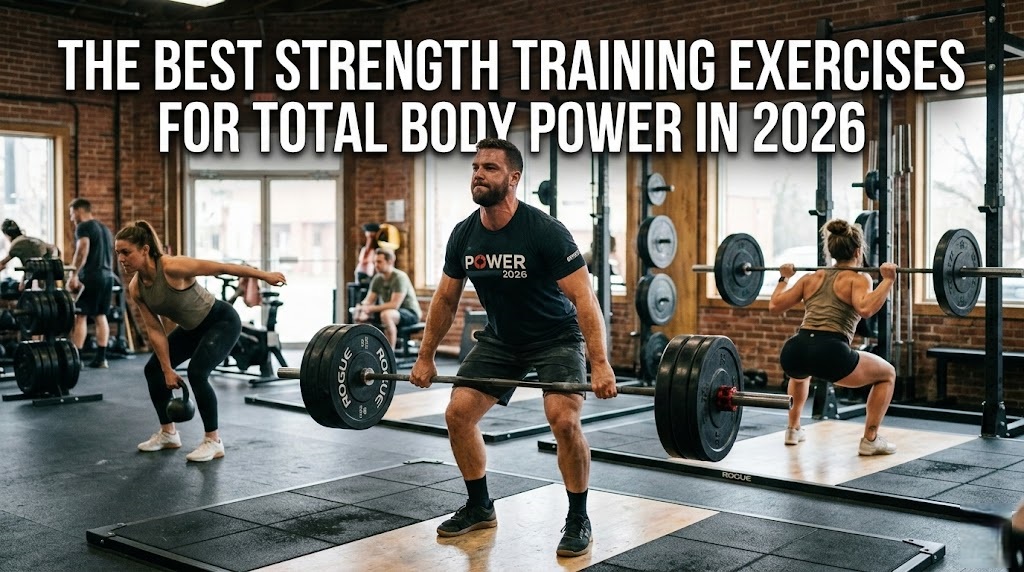
The Foundation of Strength
With countless exercises to choose from, it's easy to get lost in the noise. But if your goal is total body power — the ability to generate force with your entire body — some exercises are simply better than others.
In early 2026, the Journal of Strength and Conditioning Research published a comprehensive analysis of exercise effectiveness based on EMG activity, force production, and transfer to athletic performance. Researchers ranked exercises by their ability to develop total body power. Here are the results.
The 2026 Research
Key finding: The most effective exercises for total body power are compound movements that engage multiple joints, require core stability, and allow for heavy loading. Isolation exercises have their place but cannot match the power-building potential of these foundational movements.
Top 10 Strength Exercises for Total Body Power
Deadlift
The king of total body power. The deadlift engages more muscles than any other exercise — posterior chain, core, grip, traps, and even lats. It teaches you to generate force from the ground up and builds functional strength that transfers to everything.
Barbell Squat (Back Squat)
The squat is the foundation of lower body power. It builds strength in the quads, glutes, hamstrings, and core while teaching total body tension. Research shows it has the highest transfer to athletic movements like jumping and sprinting.
Barbell Hip Thrust
2026 research confirms the hip thrust as the most effective glute activator. It isolates hip extension better than squats or deadlifts while still allowing heavy loading. Essential for sprinting, jumping, and overall power.
Power Clean
The ultimate power development exercise. The power clean trains the triple extension (ankle, knee, hip) explosively, teaching the nervous system to produce force rapidly. EMG studies show near-maximal activation of posterior chain and traps.
Barbell Row (Bent Over Row)
The king of upper body pulling. The barbell row builds back thickness, biceps, and grip strength while requiring massive core stability to maintain position. Essential for total body power and posture.
Barbell Bench Press
The primary upper body pushing movement. The bench press builds pressing power, triceps strength, and chest development. Research shows it has the highest transfer to pushing movements in sports.
Weighted Pull-Up
The ultimate upper body pulling movement for power. Adding weight to pull-ups builds relative strength, back width, and grip like nothing else. It also requires massive core tension to stabilize the body.
Standing Overhead Press (OHP)
The best deltoid builder and a true test of total body tension. The standing OHP requires core stability, balance, and shoulder power. It builds pressing strength that carries over to all overhead movements.
Farmer's Walk (Loaded Carry)
Often overlooked, loaded carries build functional total body tension like nothing else. They develop grip strength, core stability, trap mass, and work capacity. Research shows they're excellent for building resilience.
Dip (Weighted)
The dip is a superior pushing movement that allows for heavy loading through a full range of motion. It builds the lower chest, triceps, and shoulders while requiring stability through the shoulders and core.
Best Exercises by Category
Lower Body Power
- #1: Barbell Squat
- #2: Deadlift
- #3: Barbell Hip Thrust
- Honorable mention: Trap Bar Deadlift, Bulgarian Split Squat
Upper Body Push
- #1: Barbell Bench Press
- #2: Standing Overhead Press
- #3: Weighted Dip
- Honorable mention: Incline Press, Push Press
Upper Body Pull
- #1: Weighted Pull-Up
- #2: Barbell Row
- #3: Pendlay Row
- Honorable mention: T-Bar Row, Chest Supported Row
Explosive Power
- #1: Power Clean
- #2: Hang Clean
- #3: Jump Squat
- Honorable mention: Kettlebell Swing, Box Jump
Why These Exercises Build Power
Compound Movement
All exercises engage multiple joints and muscle groups simultaneously, teaching your nervous system to coordinate force production across the entire body.
Heavy Loading Potential
These exercises allow for progressive overload with heavy weights (80-90%+ of 1RM), which is essential for building maximal strength and power.
Rate of Force Development
Movements like the power clean and jump squat train the nervous system to produce force rapidly, improving athletic performance and explosive power.
Core Integration
All exercises require core stability to transfer force between upper and lower body, building functional strength that carries over to real-world activities.
How to Program for Total Body Power
2026 Programming Guidelines
- Strength focus (heavy): 3-5 sets of 3-6 reps at 80-90% 1RM
- Power focus (explosive): 5-8 sets of 1-3 reps at 60-70% 1RM, performed explosively
- Frequency: Train each main lift 1-2x per week with 48-72 hours recovery
- Order: Olympic/power movements first, then heavy compounds, then accessory work
Sample Total Body Power Workout
Power Day A (Strength Focus)
- Barbell Squat 4x5 @ 85% 1RM
- Barbell Bench Press 4x5 @ 85% 1RM
- Barbell Row 4x8 @ 75%
- Farmer's Walk 3x30 seconds heavy
- Planks 3x60 sec
Power Day B (Explosive Focus)
- Power Clean 6x3 @ 65% (explosive)
- Deadlift 4x5 @ 80%
- Weighted Pull-Ups 4x6-8
- Standing Overhead Press 3x8
- Hanging Leg Raises 3x15
Common Mistakes That Kill Power
Mistake: Poor Form
Power exercises require perfect technique. Sloppy form limits force production and increases injury risk. Master the movement before adding weight.
Mistake: Too Fast, Too Heavy
Adding weight too quickly leads to form breakdown. Focus on controlled progression and technical mastery.
Mistake: Ignoring Accessories
Compound lifts are the foundation, but accessory work builds weak points. Include targeted exercises for grip, core, and smaller muscles.
Mistake: No Recovery
Power training taxes the CNS heavily. Prioritize sleep, nutrition, and deload weeks to avoid burnout and injury.
The Verdict: Build Power with These Essentials
Key Takeaways from 2026 Research
- The deadlift is #1: Engages more muscles than any other exercise for total body power
- Squats build lower body foundation: Essential for leg strength and core stability
- Olympic lifts develop explosiveness: Power cleans train rate of force development
- Compound movements > isolation: Multi-joint exercises produce the greatest power gains
- Progressive overload is essential: Gradually increase weight to continue building power
- Recovery matters: Power training taxes the CNS — prioritize sleep and deloads
The Bottom Line
The 2026 research is clear: if you want total body power, focus on compound, multi-joint exercises that allow heavy loading. The deadlift, squat, hip thrust, power clean, and row form the foundation of any serious power-building program.
Master these movements, progress them intelligently, and support them with proper recovery. Your total body power will thank you.
Quick Reference: Top 5 Exercises
- 1. Deadlift — total body power
- 2. Barbell Squat — lower body foundation
- 3. Barbell Hip Thrust — glute power
- 4. Power Clean — explosive power
- 5. Barbell Row — back power