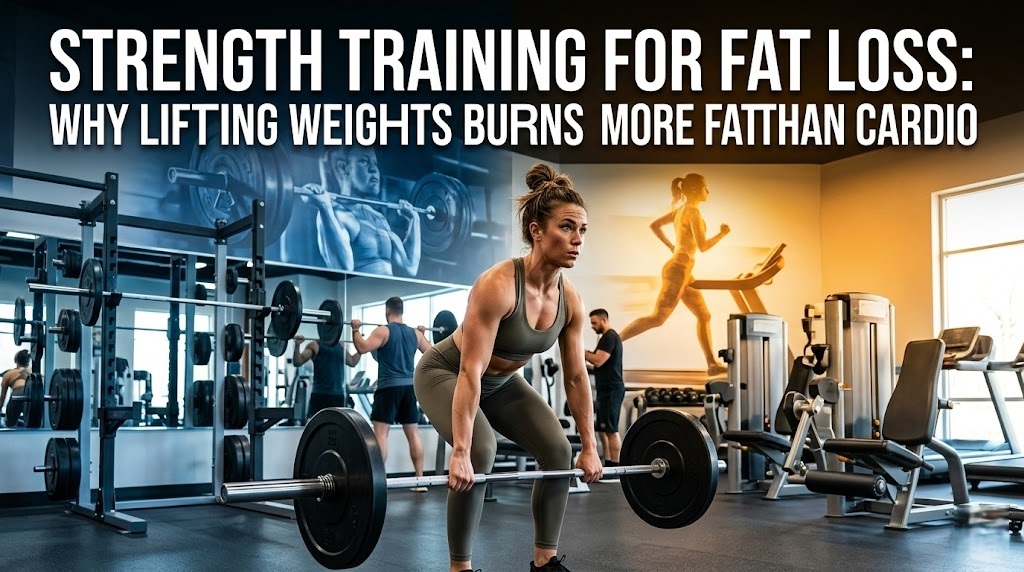
The Fat Loss Paradigm Shift
For decades, we've been told that cardio is the key to fat loss. Hop on the treadmill, log the miles, watch the fat melt away. But 2026 research tells a different story — one where lifting weights takes center stage.
A landmark meta-analysis published in Sports Medicine compared strength training and cardio for fat loss head-to-head. The results surprised even the researchers: strength training not only matches cardio for fat loss but surpasses it in ways that matter for long-term body composition.
Here's why lifting weights is the superior fat loss tool.
The 2026 Research
Key finding: When calories burned are matched, strength training and cardio produce similar fat loss during the workout. However, strength training creates a metabolic advantage that lasts for days after, while cardio's effects end when you stop moving.
5 Ways Strength Training Burns More Fat
1. The Afterburn Effect (EPOC)
Excess Post-Exercise Oxygen Consumption (EPOC) is the calories your body burns after exercise to return to baseline. Strength training elevates EPOC significantly more than cardio because it creates greater metabolic disturbance.
Cardio: EPOC lasts 1-2 hours, burning 5-10% of workout calories
Strength training: EPOC lasts 24-48 hours, burning 10-20% of workout calories
2. Muscle Building
Muscle is metabolically active tissue. Every pound of muscle you build increases your resting metabolic rate (RMR). Over months and years, this adds up to significant calorie burn without any extra effort.
The math: Gaining 2kg of muscle increases your daily RMR by ~30 calories. That's 10,000+ calories per year burned while sitting on the couch.
3. Muscle Preservation During Calorie Deficit
When you're in a calorie deficit, your body wants to burn both fat and muscle for energy. Strength training sends a powerful signal: "We need this muscle — preserve it." Cardio doesn't provide that signal.
Studies show that dieters who strength train lose almost entirely fat. Those who only do cardio can lose significant muscle, which lowers metabolism and leads to "skinny fat" results.
4. Hormonal Response
Heavy lifting triggers release of growth hormone and testosterone, both of which promote fat burning and muscle building. Cortisol (stress hormone) can actually increase with excessive cardio, promoting belly fat storage.
5. Time Efficiency
Because of EPOC and metabolic effects, a 30-minute strength session can produce the same total 24-hour calorie burn as 60 minutes of steady-state cardio. For busy people, this is a game-changer.
Head-to-Head: 12-Week Comparison
Strength Training Group
- Fat lost: 4.2kg
- Muscle gained: 1.5kg
- Body composition change: +1.5kg muscle, -4.2kg fat
- Metabolism after: Increased RMR
- 24hr calorie burn (post-workout): 15% higher than baseline
Cardio Only Group
- Fat lost: 3.8kg
- Muscle lost: 0.8kg
- Body composition change: -0.8kg muscle, -3.8kg fat
- Metabolism after: Unchanged or slightly decreased
- 24hr calorie burn (post-workout): 5% higher than baseline
The Afterburn Effect: Detailed Comparison
Strength Training
Duration: 24-48 hours
Magnitude: 10-20% of workout calories
HIIT Cardio
Duration: 4-12 hours
Magnitude: 6-15% of workout calories
Steady-State Cardio
Duration: 1-2 hours
Magnitude: 5-10% of workout calories
Why Muscle Matters for Fat Loss
The Metabolic Multiplier
Every kilogram of muscle you carry burns about 13-15 calories per day at rest. That might not sound like much, but consider:
- Gain 2kg muscle: +30 calories/day RMR = 10,950 calories/year
- Gain 5kg muscle: +75 calories/day RMR = 27,375 calories/year
- That's equivalent to: 3-8kg of fat loss per year without changing anything else
The Compound Effect
Over 5 years, building 5kg of muscle can mean 35-40kg of additional fat loss compared to someone who never built that muscle. Strength training is an investment in your metabolic future.
Best Strength Training Protocol for Fat Loss
Compound Lifts First
Squats, deadlifts, presses, rows. These create the greatest metabolic disturbance and hormone response.
Moderate-High Reps
8-15 reps per set. This range maximizes metabolic stress and calorie burn during the workout.
Short Rest Periods
60-90 seconds between sets. Keeps heart rate elevated and increases EPOC.
3-4 Sessions Weekly
Full body or upper/lower splits. Enough frequency to stimulate muscle without overtraining.
Progressive Overload
Gradually increase weight, reps, or sets. Muscle growth drives metabolic increase.
Add Cardio Strategically
2-3 sessions of low-intensity cardio (walking) or 1-2 HIIT sessions can complement, not replace, strength work.
Sample Fat Loss Strength Workout
Full Body Fat Burner (3 rounds, rest 90 sec between rounds)
- Barbell Squats 3x10-12
- Barbell Bench Press 3x10-12
- Barbell Rows 3x10-12
- Romanian Deadlifts 3x12-15
- Overhead Press 3x10-12
- Plank 3x45-60 sec
Does Cardio Have a Role?
Yes, But as a Supplement, Not the Main Event
- Walking/LISS: Great for active recovery, doesn't interfere with strength gains
- HIIT: Good for cardiovascular health, but can impede recovery if overdone
- Steady-state cardio: Fine in moderation, but prioritize strength training first
The optimal approach: strength train 3-4x weekly, add 2-3 LISS sessions (walking) for extra calorie burn without interfering with recovery.
Common Myths About Strength Training and Fat Loss
Myth: "Lifting weights makes you bulky"
Truth: Building significant muscle requires years of dedicated training and often a calorie surplus. Strength training while losing fat builds lean, toned physique — not bulky.
Myth: "You need to do cardio to lose fat"
Truth: Fat loss comes from calorie deficit. Strength training creates that deficit while preserving metabolism. Cardio is optional.
Myth: "Light weights, high reps tone fat"
Truth: "Toning" is just building muscle while losing fat. Heavy weights build muscle efficiently. Light weights don't provide enough stimulus.
Myth: "Women should train differently"
Truth: Women benefit from the same strength training principles as men. Same exercises, same intensity, same results.
The Verdict: Lift for Lasting Fat Loss
Key Takeaways from 2026 Research
- Strength training creates afterburn: 24-48 hours of elevated metabolism
- Builds metabolic tissue: Muscle burns calories 24/7
- Preserves muscle during dieting: Prevents metabolism crash
- Better body composition: Lose fat, gain or maintain muscle
- Time-efficient: 30-45 minutes, 3-4x weekly
- Long-term results: Metabolic benefits compound over years
The Bottom Line
The 2026 research is clear: if your goal is fat loss, strength training should be your primary tool. Cardio has its place, but lifting weights provides metabolic benefits that cardio simply can't match — longer afterburn, muscle preservation, and a higher resting metabolism that compounds over time.
Don't abandon cardio entirely if you enjoy it. But make strength training the foundation of your fat loss program. Your metabolism — and your physique — will thank you.
Quick Reference: Fat Loss Training
- ✅ Strength train 3-4x weekly (compound lifts, 8-15 reps, 60-90 sec rest)
- ✅ Add 2-3 LISS sessions (walking) if desired
- ✅ Prioritize protein (1.6-2.2g/kg) to preserve muscle
- ✅ Calorie deficit of 300-500 calories
- ✅ Progressive overload — keep challenging muscles
- ✅ Be patient — muscle builds slowly, but metabolic effects last