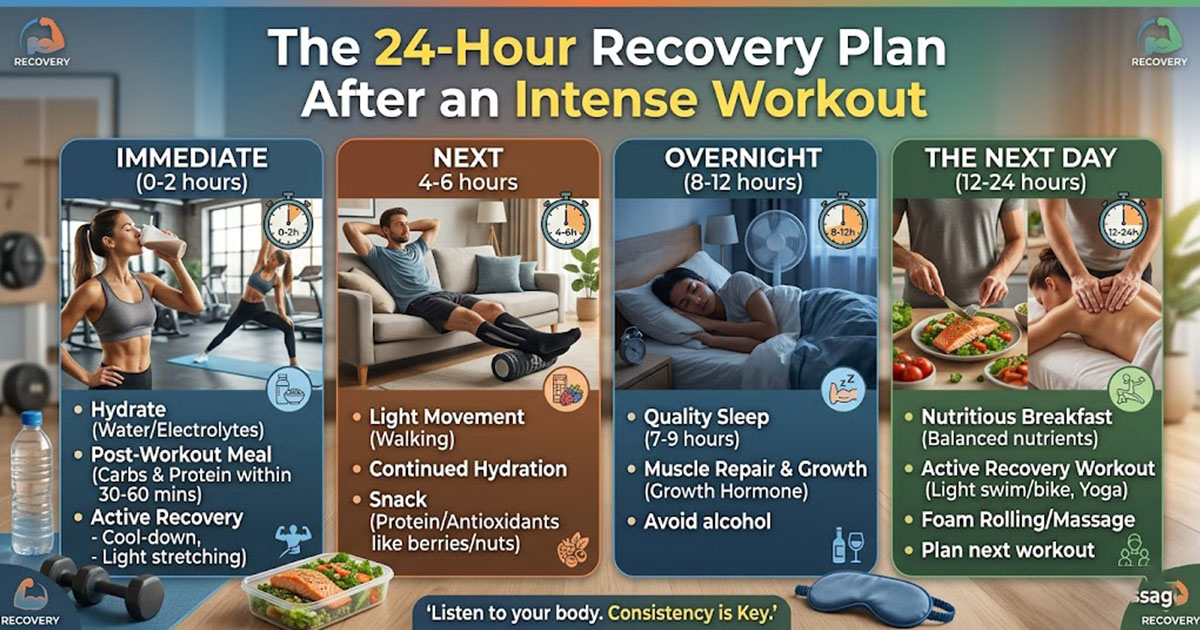
The 24 Hours That Determine Your Progress
You just finished an intense workout. Your muscles are pumped, your heart rate is elevated, and you feel accomplished. But what you do in the next 24 hours will determine whether that effort translates into progress—or gets wasted.
Jason Pullara, Director of Strength & Conditioning at Purdue University, explains: "Recovery should not be viewed as passive, optional, or reactive, but as an active component of training that directly influences performance outcomes" . The 24 hours after an intense workout are when your body repairs damage, replenishes energy stores, and builds stronger tissue.
In 2026, research has mapped the recovery timeline with unprecedented precision. A randomized controlled trial in Frontiers in Physiology compared different recovery strategies and found that the first 24 hours follow a predictable pattern with distinct windows of opportunity . Another study on elite basketball players demonstrated that the right recovery interventions can prevent exercise-induced muscle damage and improve performance 24 hours later .
This article presents the science-backed 24-hour recovery plan—hour by hour—so you can maximize every workout and come back stronger.
The 2026 Research
Key finding: Recovery follows a predictable 24-hour timeline with distinct phases. The first 2 hours are critical for refueling, 2-6 hours for repair, and sleep (6-9 hours) for deep regeneration. Cold water immersion, active recovery, and nutrition all play specific roles when timed correctly .
The Recovery Pyramid: Your Guiding Framework
Before diving into the hour-by-hour plan, it's essential to understand the hierarchy of recovery. Pullara's team at Purdue organizes recovery around three guiding principles: building up the recovery pyramid, being specific with the type of recovery required, and periodizing recovery across the training year .
Base: Sleep, Nutrition & Hydration
These factors account for the majority of recovery potential and must be consistently addressed before additional recovery strategies are layered on top . Without this foundation, other modalities provide limited benefit.
Middle: Active Recovery & Mobility
Light movement, Zone 2 cardio, and stretching support circulation and reduce stiffness without adding fatigue .
Top: Advanced Modalities
Cold water immersion, contrast therapy, compression, and massage provide incremental benefits but should never replace the foundation .
The 24-hour plan that follows builds on this pyramid, ensuring you address the foundation first before layering advanced strategies at the right times.
The 24-Hour Recovery Timeline
What's happening: Your muscles are depleted of glycogen, muscle protein breakdown exceeds synthesis, and inflammation is beginning. Blood flow is elevated, and your body is primed to accept nutrients .
Key actions:
- Hydrate: Drink 16-24 ounces of water with electrolytes. A study on elite athletes found that replacing fluids immediately post-exercise is critical for recovery .
- Protein: Consume 20-40 grams of high-quality protein within 30-60 minutes. Research confirms this stimulates muscle protein synthesis and reduces breakdown .
- Carbohydrates: Add 30-60 grams of fast-digesting carbs to replenish glycogen. This is especially important if you have another workout within 24 hours .
- Cool-down: 5-10 minutes of light movement (walking, easy cycling) to promote blood flow and begin the transition to recovery .
Natural options: Chocolate milk provides an excellent 4:1 carb-to-protein ratio. A banana with whey protein, or Greek yogurt with berries, also works perfectly .
What's happening: Your muscles remain highly receptive to nutrients. Glycogen synthase activity is elevated, meaning carbs are more efficiently stored as glycogen rather than fat . Muscle protein synthesis is ramping up.
Key actions:
- Complete meal: Eat a whole-food meal with protein, complex carbs, and vegetables. Aim for 20-40g additional protein and 40-80g carbs depending on workout intensity .
- Continue hydration: Keep drinking water. Your urine should be pale yellow within 2-3 hours post-workout .
- Optional cold exposure: If your workout was extremely high-intensity or competitive, this is the window for cold water immersion. A 2026 study found that CWI attenuated exercise-induced muscle damage and reduced perceived fatigue . However, for routine strength training, skip this to preserve adaptation .
Sample meal: Grilled chicken breast (30g protein) with sweet potato (40g carbs) and roasted vegetables. Or salmon with quinoa and steamed broccoli.
What's happening: Muscle protein synthesis peaks during this window. Inflammation is present but controlled—and it's actually necessary for adaptation. 2026 research reveals that "oxidative eustress" (controlled oxidative stress) signals your body to upgrade its antioxidant defenses and mitochondrial capacity .
Key actions:
- Move lightly: If you feel stiff, gentle walking or mobility work promotes blood flow without interfering with repair. Avoid prolonged sitting .
- Anti-inflammatory nutrition: Eat whole foods rich in polyphenols—berries, tart cherries, leafy greens, and fatty fish. These support the resolution of inflammation without blunting adaptation .
- Avoid high-dose antioxidants: 2026 research warns that high-dose vitamin C or E supplements may interfere with training adaptations by prematurely clearing the signaling molecules that trigger adaptation . Get antioxidants from food, not pills.
- Compression (optional): If you have compression garments, wearing them during this window may reduce perceived soreness, though evidence is mixed .
Snack idea: A smoothie with berries, spinach, protein powder, and tart cherry juice provides polyphenols and protein.
What's happening: Glycogen stores are mostly replenished if you've eaten enough carbs. Muscle protein synthesis remains elevated but gradually declines. Your nervous system is still recovering from the sympathetic activation of exercise .
Key actions:
- Evening meal: Another balanced meal with protein, carbs, and vegetables. Don't restrict calories on recovery days—your body needs fuel to repair .
- Nervous system regulation: Practice 5-10 minutes of breathwork (box breathing, 4-7-8 breathing) to shift into parasympathetic "rest and digest" mode. 2026 research confirms this improves heart rate variability and accelerates systemic recovery .
- Light stretching: Gentle, non-intensive stretching can maintain range of motion without stressing recovering muscles.
- Reduce blue light: Begin dimming lights and avoiding screens 1-2 hours before bed to support melatonin production.
Breathwork protocol: Box breathing—4 counts in, hold 4, out 4, hold 4—for 5 minutes. This shifts nervous system state .
What's happening: Sleep is when the majority of repair happens. During deep sleep (N3), growth hormone release peaks, muscle protein synthesis accelerates, and the nervous system resets. Research in the Journal of Clinical Sleep Medicine confirms that extending sleep improves reaction time, accuracy, and mood .
Key actions:
- Prioritize 7-9 hours: This is non-negotiable. If you only adopt one recovery habit, make it this .
- Cool room: Keep bedroom temperature 65-68°F (18-20°C). Cooler temperatures increase deep sleep duration .
- Consistent timing: Go to bed and wake up at the same time. Consistency regulates your circadian rhythm and improves sleep quality .
- Pre-sleep nutrition (optional): A small amount of casein protein (cottage cheese, Greek yogurt) before bed may support overnight muscle protein synthesis.
- Magnesium: 400mg magnesium glycinate can improve sleep onset by ~17 minutes and supports muscle relaxation .
Wake-up check: Upon waking, assess your readiness. If resting heart rate is elevated 5+ beats above normal, consider lighter training .
The Morning After: Your 24-Hour Check-In
At the 24-hour mark, you should assess how well your recovery went. A January 2026 study in Life measured recovery markers at 24 hours post-exercise and found significant differences based on recovery strategies used .
24-Hour Recovery Assessment
- Performance test: Countermovement jump height or isometric strength—if these are near baseline, recovery is on track .
- Perceived fatigue: Rate your energy on a 1-10 scale. If it's still elevated, consider active recovery today.
- Muscle soreness: Some soreness is normal. Sharp, localized pain is not.
- Resting heart rate: If elevated 5+ beats above normal, you may need more recovery .
What the Research Shows
A 2026 randomized crossover trial found that cold water immersion, active recovery, and protein-carb supplementation all prevented the 24-hour exercise-induced increase in creatine kinase (a marker of muscle damage) compared to placebo . However, cold water immersion was most effective for improving physical performance at 24 hours .
Recovery Methods: What Works Best at 24 Hours
Nutrition Strong Evidence
A 2026 study found that protein-carb supplementation prevented the 24-hour increase in creatine kinase compared to placebo . Active adults consumed more protein (82g vs 79g daily) and had healthier body composition .
Protocol: 20-40g protein within 2 hours, repeated at meals. Total daily intake matters most .
Cold Water Immersion Context-Dependent
CWI significantly improved 4×10m shuttle run performance at 24 hours and decreased fatigue and RPE immediately after application . However, frequent use after strength training may blunt hypertrophy adaptations .
Best use: After competition or high-intensity conditioning, not routine strength sessions.
Active Recovery Good Evidence
Low-intensity movement (Zone 2 cardio) improved blood flow and cleared metabolic byproducts without adding stress . The 2026 crossover trial found ACT decreased fatigue and RPE immediately after application .
Protocol: 20-40 minutes of light cycling, walking, or swimming on rest days .
Sleep Essential
Sleep remains the most powerful recovery tool. Research shows extending sleep improves reaction time, accuracy, and mood . Without adequate sleep, other methods provide limited benefit .
Protocol: 7-9 hours, consistent timing, cool room .
The 2026 Meta-Analysis Finding
A network meta-analysis in Frontiers in Physiology found that cold compression therapy ranked highest for reducing muscle soreness, while far-infrared therapy was most effective for improving countermovement jump height . This supports a personalized approach to recovery.
Common 24-Hour Recovery Mistakes
Mistake 1: Treating Sleep as Optional
"I'll catch up later" doesn't work. During deep sleep, growth hormone and testosterone surge, driving repair. When sleep is repeatedly short, that repair window shrinks . Pick a realistic sleep target and protect it .
Mistake 2: Post-Training Nutrition Left to Chance
"I eat enough overall" isn't enough. Timing matters, especially when recovery time is short. Build a default plan for after training—a simple snack covering carbs and protein .
Mistake 3: Overdoing Cold Exposure
Frequent ice baths after strength training may blunt muscle growth adaptations . Use cold immersion strategically after high-intensity sessions, not routine workouts .
Mistake 4: High-Dose Antioxidants
2026 research warns that long-term high-dose antioxidant supplements (vitamin C, E) may interfere with training adaptations by prematurely clearing the signals that trigger adaptation . Get antioxidants from whole foods.
Mistake 5: Ignoring Life Stress
When life stress is high, the same training load costs you more. Even if your program looks perfect on paper, your overall stress budget might already be maxed out . On high-stress weeks, maintain frequency but reduce intensity slightly.
Mistake 6: Rushing Back After Injury
Feeling better is not the same as being ready. Pain often changes faster than capacity. Return in stages: controlled movements first, then intensity, then volume, then sport-specific demands last .
The Nervous System Factor
One of the biggest shifts in 2026 recovery science is the focus on the nervous system. Training activates the sympathetic nervous system ("fight or flight"). Recovery requires shifting into parasympathetic dominance ("rest and digest") .
Breathwork Protocols for Nervous System Recovery
- Box breathing: 4 counts in, hold 4, out 4, hold 4. Repeat for 5 minutes.
- 4-7-8 breathing: Inhale 4, hold 7, exhale 8.
- Extended exhale breathing: Exhale longer than inhale (e.g., 4 in, 6 out).
- Nasal-only recovery sessions: Breathe only through nose during light activity.
Studies in Frontiers in Human Neuroscience show that slow breathing techniques improve heart rate variability—a key marker of recovery readiness . Just 5-10 minutes post-training can lower stress hormones and accelerate systemic recovery.
Natural Recovery: The Whole-Food Approach
2026 research emphasizes that whole foods often outperform isolated supplements. A complete guide to natural post-workout recovery highlights several key principles :
Protein Sources
- Eggs (complete amino acid profile)
- Greek yogurt (protein + probiotics)
- Lean meats (high bioavailability)
- Legumes (plant-based + fiber)
Anti-Inflammatory Foods
- Fatty fish (omega-3s)
- Berries (antioxidants)
- Leafy greens (magnesium)
- Turmeric and ginger
- Tart cherry juice (melatonin + anthocyanins)
The Whole-Food Advantage
Natural recovery methods work because they support your body's existing systems rather than trying to override them. Unlike synthetic supplements that can create dependency or mask underlying issues, natural methods enhance your body's innate ability to heal and adapt .
The Complete 24-Hour Recovery Protocol
Your Hour-by-Hour Checklist
- 0-1 hour: Hydrate (16-24 oz), 20-40g protein, 30-60g carbs, 5-10 min light cool-down
- 1-2 hours: Complete meal with protein, complex carbs, vegetables. Continue hydration.
- 2-6 hours: Light movement if stiff, polyphenol-rich foods, avoid high-dose antioxidants
- 6-12 hours: Evening meal, 5-10 min breathwork, reduce blue light, gentle stretching
- Sleep (7-9 hours): Cool room (65-68°F), consistent timing, optional magnesium glycinate
- Wake-up: Assess readiness (RHR, soreness, energy), adjust today's training accordingly
The Verdict: Your 24 Hours Matter
Key Takeaways from 2026 Research
- The first 2 hours are critical: Protein, carbs, and hydration within this window optimize muscle repair .
- Sleep is non-negotiable: 7-9 hours of quality sleep drives growth hormone release and tissue repair .
- Cold water immersion works—but strategically: Use after high-intensity sessions, not routine strength training .
- Active recovery beats complete rest: 20-40 minutes of Zone 2 cardio improves blood flow and reduces stiffness .
- Nervous system matters: Breathwork shifts you into parasympathetic mode, accelerating systemic recovery .
- Whole foods outperform supplements: Get antioxidants from food, not high-dose pills, to preserve training adaptations .
The Bottom Line
The 2026 research is clear: the 24 hours after an intense workout are a structured process, not a passive waiting period. Your body follows a predictable timeline of repair, refueling, and adaptation. When you align your recovery strategies with this timeline—protein timing, strategic cold exposure, active recovery, nervous system regulation, and sleep—you accelerate results and reduce injury risk .
As the Evolve MMA guide concludes, "The athletes who improve the fastest are not always the ones who train the hardest. They are the ones who recover the smartest" .
Your 24-Hour Challenge
- ✅ After your next intense workout, follow this hour-by-hour plan
- ✅ Track how you feel at 24 hours—energy, soreness, readiness
- ✅ Compare to your usual recovery approach
- ✅ Adjust based on what works for your body
- ✅ Remember: Recovery is training