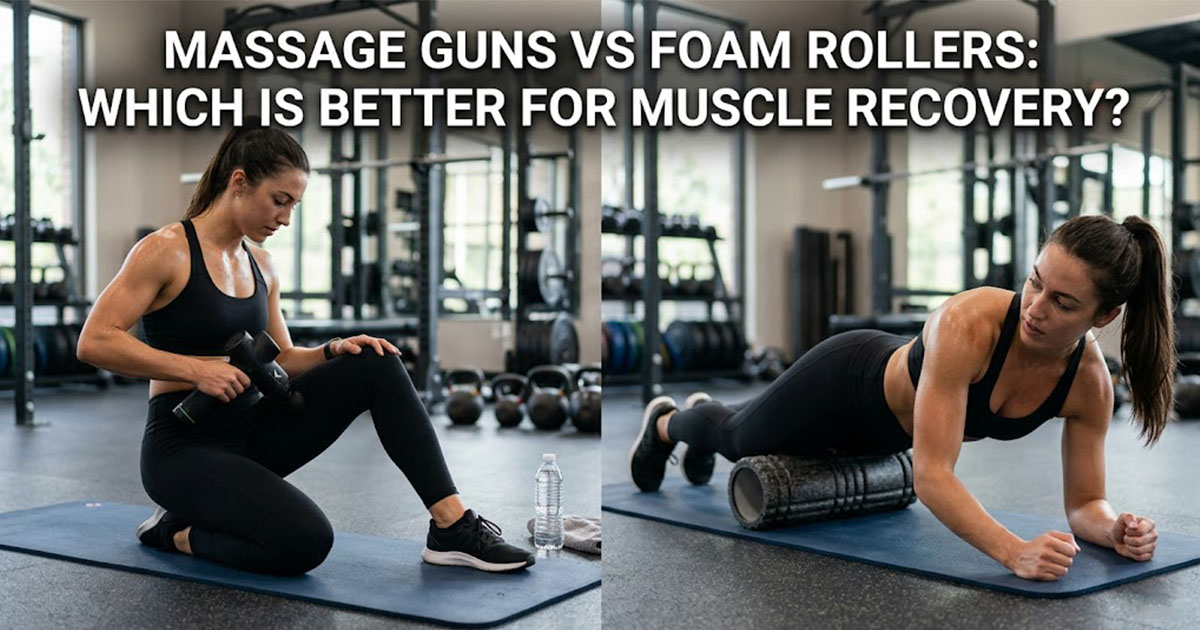
The Great Recovery Debate
Walk into any gym or scroll through fitness social media, and you'll see two tools dominating the conversation: the humble foam roller and the increasingly popular massage gun. Both promise faster recovery, less soreness, and better performance. But which one actually works?
In early 2026, a comprehensive literature review published in the journal *Quality in Sport* analyzed 20 peer-reviewed studies comparing foam rolling (FR) and percussive therapy (PT) head-to-head . The results reveal that these two tools work through fundamentally different mechanisms and excel at different tasks .
Meanwhile, a new study in the *Journal of Sports Science and Medicine* tested vibration rolling against regular rolling and static stretching—and found some surprising results about what actually drives recovery . And a survey of 452 health professionals revealed a troubling gap between what practitioners believe and what the evidence actually shows .
This article synthesizes the latest 2026 research to answer the question once and for all: massage guns vs foam rollers—which is better for muscle recovery?
The 2026 Research
Key finding: Foam rolling and percussive therapy work differently. PT is superior for acute flexibility improvements (up to 11.4% increase in ROM), while FR performs better for metabolic recovery, neuromuscular efficiency, and soreness management . Neither tool during a warm-up improves acute performance .
Head-to-Head: How They Work
Massage Guns (Percussive Therapy)
Deliver rapid pulses (1,200-3,200 per minute) into muscle tissue, penetrating deep into muscle bellies .
Foam Rollers
Self-myofascial release using body weight to apply sustained pressure across muscle groups .
Full Feature Comparison
| Feature | Foam Roller | Massage Gun |
|---|---|---|
| Mechanism | Static/dynamic pressure via body weight | Rapid percussive pulses (1,800–3,200/min) |
| Depth of Penetration | Moderate (superficial to mid-layer) | Deep (reaches deeper muscle bellies) |
| User Effort Required | High (requires body movement) | Low (device does the work) |
| Target Precision | Broad muscle groups only | Pinpoint (piriformis, rotator cuff) |
| Portability | Limited (bulky) | High (compact, battery-powered) |
| Average Cost | $15–$50 | $100–$600 |
| Noise Level | Negligible | High (55-75 dB) |
What 2026 Research Reveals
Percussive Therapy vs Foam Rolling Literature Review
Key findings:
- PT demonstrated higher levels of acute flexibility improvements, with up to 11.4% increase in hamstring ROM
- FR effectively reduced DOMS at 48 and 72 hours post-exercise
- FR maintains neuromuscular efficiency by increasing voluntary activation
- FR showed advantages in metabolic recovery by improving blood flow and lactate clearance
- No evidence that either technique during warm-up improves acute performance
- Improper use of PT may lead to severe complications, including rhabdomyolysis
Vibration Rolling vs Regular Rolling vs Static Stretching
Key findings: Vibration rolling did not outperform regular rolling or static stretching in terms of outcomes runners actually care about—muscle damage signals, inflammation signals, or performance recovery—over the 48-hour window .
Inflammatory markers (CRP and IL-6) didn't meaningfully change across time in a way that separated the interventions. Muscle stiffness didn't show a clear improvement attributable to any one method .
Takeaway: "You may feel better in the moment, but your muscle-damage and inflammation signals, plus basic performance markers, mostly follow their own timeline" .
Practitioner Beliefs vs Evidence
A survey of 452 health professionals found that only 2 of 15 evidence-based items reached the 80% correct response threshold .
Evidence consistently supports: Acute increases in ROM, short-term pain reduction, and transient improvements in muscle stiffness and blood flow .
Evidence is limited/inconclusive for: Performance enhancement, injury prevention, and "fascial adhesion release" .
TENS vs Foam Rolling Study
A randomized controlled trial with elite female volleyball players compared TENS, foam rolling, and passive rest .
Both active recovery methods preserved jumping ability better than passive rest, with no significant difference between them .
Winner: Massage Guns for Flexibility
The evidence is clear: if your primary goal is acute flexibility gains, the massage gun wins. The literature review found that percussive therapy demonstrated "higher levels of acute flexibility improvements in several studies, with up to an 11.4% increase in the range of motion for the hamstring muscle" .
This makes massage guns particularly valuable for pre-workout preparation or when you need to quickly improve range of motion before an activity. However, note that neither tool improved acute performance—so don't expect a massage gun to make you jump higher immediately after use .
Winner: Foam Rollers for Soreness and Metabolic Recovery
When it comes to delayed onset muscle soreness (DOMS), foam rollers have the edge. The research confirms that FR "effectively reduces DOMS at 48 and 72 hours post-exercise" .
The landmark Pearcey et al. (2015) study, cited in the review, found that "FR maintains neuromuscular efficiency by increasing voluntary activation, thereby accelerating the return to baseline performance" .
FR also "showed advantages in metabolic recovery by improving local blood flow and blood lactate clearance" . A 2024 study in *Sports* confirmed that "foam rolling intervention improves lactate clearance after high-intensity exercise" .
Winner: Massage Guns for Targeted Relief
If you have specific trigger points or hard-to-reach areas, the massage gun is your tool. Unlike foam rollers, which work best on broad areas like quadriceps and hamstrings, massage guns allow "pinpoint targeting" of spots like the piriformis, rotator cuff, or IT band .
As one expert put it: "Percussion therapy isn't inherently superior—it's more about matching the tool to the need. For localized knots, a massage gun excels. For general warm-up or cooldown, foam rolling remains effective" .
Safety Considerations
Massage Gun Risks
- Improper use can lead to severe complications, including rhabdomyolysis
- Never use on bones, joints, or tendons
- Avoid staying on one spot for more than 15 seconds
- Start on lowest setting and build up
- Keep away from neck and spine
- Avoid using on inflamed or injured tissue—wait 48 hours post-injury
Foam Roller Safety
- Generally safer when used correctly
- Roll slowly—about one inch per second
- Avoid direct rolling on joints and lower back
- Spend at least 30-60 seconds per muscle group
- Stop if you feel sharp pain
Practical Guide: Which Tool When?
Pre-Workout
Winner: Foam Roller
Use foam roller on major muscle groups for 5-10 minutes to increase blood flow and joint mobility. Both tools fail to improve acute performance, but rolling is gentler for warm-up .
Immediate Post-Workout
Winner: Both (strategically)
Apply massage gun to most fatigued muscles at medium intensity for 5 minutes. Follow with brief foam rolling for broader coverage .
24-48 Hours Post (DOMS)
Winner: Foam Roller
FR effectively reduces DOMS at 48 and 72 hours. The evidence strongly supports foam rolling for soreness management .
Trigger Points
Winner: Massage Gun
For localized knots and hard-to-reach areas, massage gun excels. Use bullet attachment on specific spots .
General Maintenance
Winner: Either
Choose based on preference. Both support recovery when used consistently .
Before Sleep
Winner: Massage Gun
Light percussive therapy on lingering tight spots can support overnight recovery .
Is a Massage Gun Worth the Investment?
This is the million-dollar question—literally, given the price difference. Here's a decision matrix based on expert recommendations :
Choose Massage Gun If:
- You have frequent localized muscle knots
- You struggle to reach certain areas (back, glutes)
- You train intensely 4+ times weekly
- You have budget for $150+ investment
- You value convenience and speed
- You travel often (compact portability)
Choose Foam Roller If:
- You want an affordable, durable tool ($15-$50)
- Your routine involves full-body training
- You prefer passive, meditative recovery
- You're new to myofascial release
- You primarily need broad muscle work
The Verdict from Athlete Testing
A three-week trial with 20 active participants found: "massage guns provided faster relief from acute soreness, especially in smaller muscle groups like calves and glutes. However, foam rollers were preferred for full-leg sessions and pre-workout activation due to their broader coverage and quiet operation" .
Common Mistakes to Avoid
Mistake 1: Using on Bones or Joints
Never use either tool on bones, joints, or tendons. Always glide over muscle tissue .
Mistake 2: Overuse
Excessive pressure or duration can lead to microtrauma or inflammation . Limit massage gun sessions to 2-3 minutes per muscle group .
Mistake 3: Rolling Too Fast
Rushing reduces effectiveness and may irritate tissues. Roll slowly—about one inch per second .
Mistake 4: Believing the "Fascial Adhesion" Myth
Evidence for "fascial adhesion release" is limited or inconclusive . The benefits are likely neurological, not structural.
Mistake 5: Expecting Performance Gains
No evidence that either tool during warm-up improves acute performance . Use them for recovery, not performance.
Mistake 6: Ignoring the Foundation
These tools supplement—not replace—sleep, nutrition, and hydration. Put your real recovery budget into things that actually work .
The Optimal Combined Protocol
Science-Backed Recovery Routine
- Pre-workout (5-10 min) Foam roller on major muscle groups to increase blood flow and mobility
- Immediate post-workout (5 min) Massage gun on most fatigued muscles, medium intensity
- Within 30 min Brief foam rolling combined with static stretching
- Evening (3-5 min) Massage gun on lingering tight spots to support overnight recovery
- Next morning (if sore) Light foam rolling + dynamic movement
The Smart Approach
As the 2026 research concludes: "The choice between a foam roller and a massage gun isn't about which is universally better—it's about matching the tool to your lifestyle and goals" .
The Verdict: Both Have Their Place
Key Takeaways from 2026 Research
- Massage guns win for acute flexibility: Up to 11.4% increase in ROM
- Foam rollers win for soreness and metabolic recovery: Effective at 48-72h, improves lactate clearance
- Neither improves acute performance: Use for recovery, not pre-workout boost
- Evidence supports ROM gains and pain reduction: But not "fascial release" or injury prevention
- Vibration doesn't outperform regular rolling: Your body follows its own recovery timeline
- Safety matters: Improper massage gun use can cause rhabdomyolysis
The Bottom Line
The 2026 research is clear: massage guns and foam rollers are complementary tools, not competitors. If you need acute flexibility or have specific trigger points, a massage gun is worth the investment. If you're dealing with general soreness, metabolic recovery, or want an affordable, durable option, foam rolling remains the proven choice .
As one researcher concluded: "Treatment modalities should be individualised, with an emphasis on functional recovery rather than acute performance" . And as the Marathon Handbook analysis reminds us: "If you love your vibrating roller, this study doesn't give you a strong reason to throw it out—but it also doesn't support the idea that vibration is a recovery cheat code" .
The smartest approach combines both: use a foam roller for broad, preventative work, and keep a massage gun for targeted relief when DOMS hits hard .
Your Recovery Tool Checklist
- ✅ Assess your primary need: general soreness or targeted knots?
- ✅ Consider your budget: $20 roller or $200+ gun?
- ✅ Test accessibility: can you roll your own back?
- ✅ Start simple: begin with a foam roller, upgrade only if needed
- ✅ Use correctly: never on bones, joints, or tendons
- ✅ Remember: sleep and nutrition matter more than any tool