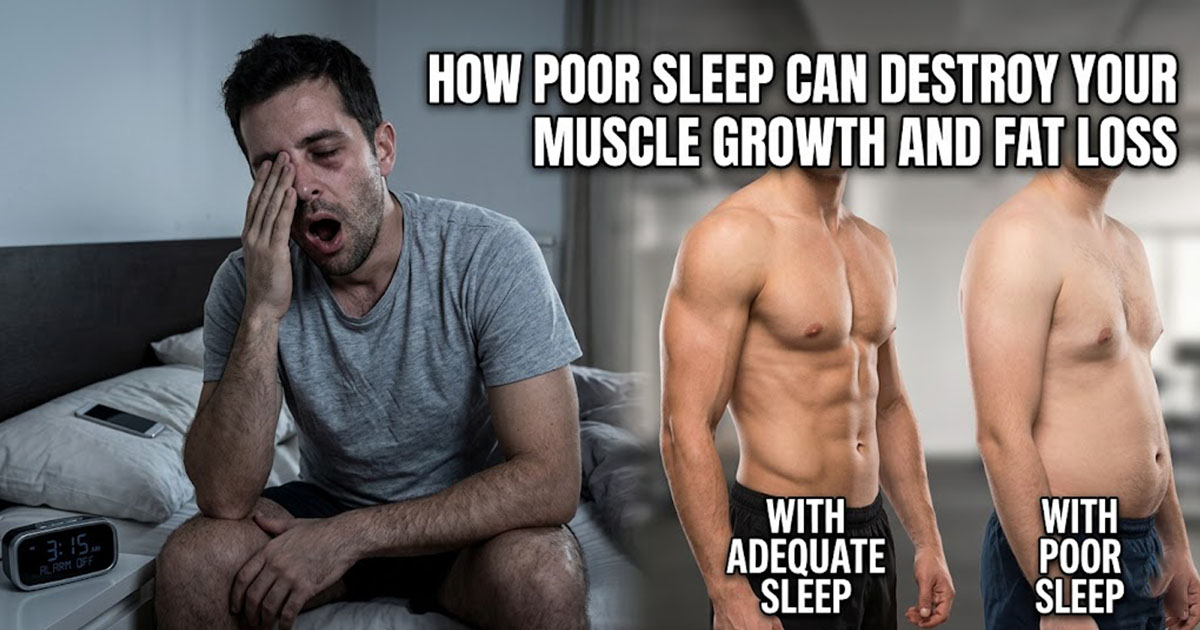
The Silent Saboteur of Your Fitness Progress
You train hard. You track your protein. You skip the junk food. But the scale won't budge, and your strength gains have stalled. What's going on?
The answer might not be in your training log or meal plan. It might be happening while you sleep—or rather, while you don't. A growing body of 2026 research reveals that poor sleep is one of the most potent saboteurs of muscle growth and fat loss, capable of undoing weeks of disciplined effort .
Dr. Abhinav Singh, a medical review panelist for SleepFoundation.org, explains: "Sleep ranks right up there with healthy eating and exercise when it comes to [attaining] healthy weight goals" . Yet for most people, it's the forgotten pillar of fitness.
This article synthesizes the latest research from Nutrients, the Journal of Clinical Investigation, and leading medical institutions to explain exactly how poor sleep destroys your muscle and fat loss goals—and what you can do about it.
The 2026 Research
Key finding: A study in Nutrients found that when sleep is consistently compressed, biological clock genes are disrupted, hormone secretion patterns shift, and muscle protein synthesis is impaired. This creates a perfect storm for muscle loss and fat gain .
The Hormonal Cascade: How Sleep Deprivation Wrecks Your Progress
Sleep is not passive rest. It's an active anabolic state where your body releases growth hormone, repairs muscle tissue, and regulates metabolic hormones. When sleep is cut short, three critical hormones go haywire .
Leptin: The Satiety Signal
Leptin signals to your brain that you're full and have enough energy stored. Sleep deprivation reduces leptin levels, causing your brain to perceive a state of starvation . According to Parsley Health's Dr. Nisha Chellam, "A reduction of sleep from 8.5 to 4 hours leads to a drop in the satiety hormone leptin by 18%" . The result: you feel hungry even when you've eaten enough.
Ghrelin: The Hunger Hormone
Ghrelin stimulates appetite. When you don't get enough sleep, ghrelin levels surge . Dr. Chellam notes a "surge in the hunger hormone ghrelin by 25%" after sleep restriction . This combination of low leptin and high ghrelin creates a powerful biological drive to eat more—especially high-calorie foods.
Cortisol: The Catabolic Stressor
Cortisol is your body's primary stress hormone. Research shows that one week of sleep restriction elevates cortisol by 37 to 50% . Elevated cortisol promotes insulin resistance, increases abdominal fat storage, and directly breaks down muscle tissue . A study from Dr. Jeffrey Spiegel's team found that sleep-deprived men had higher nighttime cortisol concentrations, mimicking hormone levels seen in much older populations .
The 300-Calorie Effect
Dr. Chellam summarizes the combined hormonal impact: "All these changes increase caloric intake by 300 calories a day—and hence, sustained weight gain" . That's 2,100 extra calories per week, or nearly 10kg of potential weight gain per year, driven entirely by hormonal shifts from poor sleep.
Testosterone and Growth Hormone: The Anabolic Demolition
For muscle growth, testosterone and growth hormone are non-negotiable. Both are released primarily during sleep. When you shortchange sleep, you shortchange your anabolic potential .
Testosterone
A landmark study published in JAMA found that one week of sleep restriction (5 hours per night) reduced testosterone levels in young healthy men by 10 to 15%—equivalent to aging 10 to 15 years . Morning testosterone pulses, which account for 70% of daily output, are particularly vulnerable to sleep disruption . For women, the disruption can blunt the natural estrogen surge in the follicular phase, affecting energy and mood .
Growth Hormone
Approximately 70% of growth hormone is released during deep slow-wave sleep . Fragmented sleep reduces deep sleep by 20 to 40%, slashing growth hormone release and muscle protein synthesis . One study found that 8 hours of sleep increased growth hormone secretion 2 to 3 times more than 5 hours . Without adequate growth hormone, muscle repair slows, and fat metabolism suffers.
The result is a double blow: you lose the hormones that build muscle while gaining hormones that break it down. This is why the GAT Sport analysis concludes, "You're not just failing to build; you're actively destroying what you've built" .
Muscle Protein Synthesis: The Overnight Gains Factory
Resistance training stimulates muscle protein synthesis (MPS) for 24 to 48 hours. But that stimulus requires the right conditions to translate into actual muscle tissue .
The MPS Reduction
Research shows that poor sleep reduces muscle protein synthesis by 18 to 30% by limiting anabolic signaling pathways . A study in Physiological Reports confirmed that sleep restriction impairs myofibrillar protein synthesis, directly compromising the muscle repair process .
The Vicious Cycle
- You train hard → create micro-tears in muscle
- You sleep poorly → MPS is blunted
- Muscle breakdown exceeds repair
- You lose muscle despite working out
The Growth Condition
- You train hard → create micro-tears in muscle
- You sleep 7-9 hours → MPS peaks
- Repair exceeds breakdown
- You build muscle from your training
As the IDEA Fitness analysis notes, "Even when total sleep time appears adequate, frequent nighttime awakenings may blunt strength gains and muscle protein synthesis" . Sleep continuity matters as much as duration.
Insulin Resistance: The Fat Storage Switch
A March 2026 study in BMJ Sub-journals identified the exact "golden sleep duration" for metabolic health: 7 hours and 19 minutes . This precise number emerged from analyzing 23,475 participants, revealing an inverted U-shaped relationship between sleep and insulin sensitivity .
The Sleep-Insulin Curve
- Sleep < 7.32 hours: Each hour of sleep below this threshold increases insulin resistance, with eGDR (a marker of insulin sensitivity) dropping significantly
- Sleep = 7.32 hours: Optimal insulin sensitivity
- Sleep > 7.32 hours: Each additional hour reduces insulin sensitivity, likely due to increased sedentary time
The mechanism involves the HPA axis: sleep deprivation activates the hypothalamic-pituitary-adrenal axis, increasing sympathetic nervous system tone and releasing inflammatory cytokines like IL-6, which induce acute insulin resistance .
The 40% Slower Clearance
Dr. Spiegel's research found that sleep-deprived men's blood sugar levels took 40% longer to drop following a high-carbohydrate meal. They also lost 30% of their ability to respond to and secrete insulin . This creates a metabolic environment primed for fat storage, particularly visceral fat.
Appetite and Cravings: The Perfect Storm
Beyond the hormonal shifts, sleep deprivation directly alters brain function in ways that make healthy eating nearly impossible .
Reward Center Activation
"Sleep loss increases activity in brain areas associated with reward," explains Dr. Marie-Pierre St-Onge. "These signals seem to increase motivation to seek foods that are high in [unhealthy] fat and calories" . Your tired brain literally craves junk food.
Food Choices Suffer
A 2020 study in the Journal of the American Heart Association found that women who slept poorly consumed more added sugars and fewer healthy unsaturated fats than those who slept well . Poor sleep doesn't just make you hungrier—it makes you crave the wrong foods.
Executive Function Declines
A 2017 report in Nature and Science of Sleep noted that poor sleep hampers executive functioning—the cognitive processes that help us organize tasks, solve problems, and manage impulses . This makes meal planning and resisting temptation significantly harder.
Energy Drops
A 2019 survey by the US National Sleep Foundation found that nearly half of adults reported that sleepiness hampered their ability to exercise . When you're tired, you move less, and NEAT (non-exercise activity thermogenesis) plummets.
The Combined Effect
This creates a perfect storm for fat gain and muscle loss: increased appetite, stronger cravings for junk food, reduced willpower, and lower physical activity—all driven by poor sleep.
The Chronotype Factor: Are You Fighting Your Biology?
A February 2026 study in Nutrients introduced the concept of "chronotype"—your natural sleep-wake preference—as a critical factor in muscle preservation .
Chronotype Categories
- Morning types: Early birds, perform best in mornings, natural sleep-wake cycle aligns with social norms
- Evening types: Night owls, biologically wired to sleep later, constantly fighting "social jet lag"
- Intermediate types: Flexible, adapt to either schedule
For evening types trying to live on a morning-type schedule, the consequences are severe. The study found that "late-type persons have lower physical activity levels and higher insulin resistance than early types, even with the same calorie intake" .
The mismatch between biological and social time—called "social jet lag"—forces your body into chronic circadian disruption. This leads to higher blood glucose levels, elevated insulin, lower leptin, and progressive muscle loss .
The Hidden Danger: Sleep Fragmentation
Even if you're in bed for 8 hours, disrupted sleep can destroy your recovery. The IDEA Fitness Association reports that "even when total sleep time appears adequate, frequent nighttime awakenings may blunt strength gains and muscle protein synthesis" .
Fragmented sleep reduces slow-wave sleep (deep sleep) by 20 to 40%, where most growth hormone is released . Athletes experiencing repeated disruptions show slower adaptation to resistance training stimuli .
Reduces strength 10-20% next day, increases perceived exertion 15%
Testosterone drops 10-15%, cortisol rises 37-50%, MPS drops 18-30%
Insulin resistance sets in, visceral fat accumulates, muscle is progressively lost
The Paradox: Sleep Extension Isn't Always the Answer
A January 2026 study in Diabetes Care delivered a surprising finding: for some people, extending sleep doesn't reverse metabolic damage .
Key Findings from the Sleep Extension Study
Researchers took 29 overweight adults with short sleep (<7 hours) and extended their sleep by 1.3 hours for 6 weeks. While sleep improved, insulin sensitivity did not .
Why? For participants with long-established metabolic dysfunction, short sleep may not be the primary driver of their insulin resistance. Obesity itself, with its chronic inflammation and adipose dysfunction, creates a metabolic resistance that isolated sleep interventions can't overcome .
The Takeaway
Sleep is foundational, but it's not magic. If you're already metabolically compromised, you need a comprehensive approach: sleep optimization plus nutrition, exercise, and stress management. As the researchers concluded, "Sleep extension is not a universal metabolic cure" .
How to Protect Your Gains: The Sleep Optimization Protocol
1. Find Your Chronotype
Are you a morning person or night owl? The Nutrients study recommends aligning your schedule with your chronotype to preserve muscle mass . If you're a night owl forced into early mornings, consider strategic adjustments rather than fighting your biology.
2. The 7.3-Hour Target
BMJ research pinpoints 7 hours 19 minutes as optimal for insulin sensitivity . Aim for this range, but prioritize consistency. "Your body thrives on predictability. Going to bed and waking up around the same time each day helps regulate your circadian rhythm" .
3. Sleep Environment
- Temperature: 60-67°F (16-19°C) to increase deep sleep 10-20%
- Light: Blackout curtains, blue-blockers after 8 PM
- Noise: Quiet or white noise
4. Pre-Bed Routine
- 60-minute screen-free wind-down
- 10-minute meditation reduces cortisol 20-30%
- Magnesium glycinate (400mg) improves sleep onset by 17 minutes
- Avoid caffeine after 2 PM (half-life 5-6 hours)
5. Morning Light Exposure
Natural light within 30 minutes of waking helps set your internal clock and supports melatonin production later that night . Open those blinds or go for a short walk.
6. Strategic Napping
For shift workers or those with unavoidable sleep loss, "banking" sleep by getting 9+ hours before deprivation reduces sleep pressure. Weekend catch-up sleep helps, but limit to 1-2 hours to avoid social jet lag .
Warning Signs: Is Poor Sleep Sabotaging You?
You're Hungry All the Time
If you feel ravenous despite adequate food intake, your leptin and ghrelin may be dysregulated from poor sleep .
You Crave Junk Food
Intense cravings for sugar and fat suggest your brain's reward centers are overactivated from sleep loss .
Your Strength Is Plateauing
If you're training consistently but not getting stronger, poor sleep may be blunting MPS and testosterone .
Belly Fat Won't Budge
Elevated cortisol from sleep deprivation specifically promotes abdominal fat storage .
You're Always Tired
Persistent fatigue despite "enough" sleep may indicate poor sleep quality and fragmentation .
You're Getting Sick Often
Sleep deprivation suppresses immune function, making you more susceptible to illness .
The Verdict: Sleep Is Non-Negotiable
Key Takeaways from 2026 Research
- Hormones go haywire: Leptin drops 18%, ghrelin surges 25%, cortisol rises 37-50% with poor sleep
- Anabolic hormones plummet: Testosterone drops 10-15%, growth hormone falls 30-50%
- Muscle protein synthesis drops 18-30%: Your body can't repair what you break down
- Insulin resistance rises: 7h19m is the metabolic sweet spot
- Appetite and cravings increase: +300 calories daily from hormonal shifts alone
- Recovery is impossible: Poor sleep creates a 10-20% strength deficit the next day
The Bottom Line
The 2026 research is unequivocal: you cannot out-train, out-diet, or out-supplement poor sleep. Sleep deprivation creates a hormonal environment that actively destroys muscle, promotes fat storage, and undermines every fitness effort you make .
As the GAT Sport analysis concludes, "The irony is that sleep is free, requires no skill, and delivers more results than any supplement or program ever could. Yet you'll spend hours researching the perfect split while scrolling Instagram at midnight. You'll buy every recovery tool except the one that actually works: unconsciousness" .
Your muscle growth and fat loss depend on what happens between 10 PM and 6 AM. Make those hours count.
Your 7-Day Sleep Challenge
- ✅ Days 1-7: Aim for 7.5 hours in bed (track actual sleep)
- ✅ Set a consistent bedtime and wake time (even weekends)
- ✅ No screens 1 hour before bed
- ✅ Keep bedroom cool (65-68°F)
- ✅ Note how your workouts feel—more energy? Better recovery?